Issue № 6 · Story I
Nothing for Sale
Nine stallholders winter on the square, and two of them, thirty-one years at adjacent pitches, want to be married in the market, in February, with the whole thing up and nothing in it. The vote goes eight to one. The one gets the clipboard.
I want it noted, before any of this, that I voted no.
There are nine of us who winter on the square, ten if you count Father Lindqvist, who is retired and not supposed to be anybody’s Father anymore but tries to look useful in weather. Nine stallholders who stay when the town empties out, and we have a Wednesday, we’ve always had a Wednesday, soup in the back of my dry goods shop because mine has the stove and the fewest opinions on the walls. That’s the whole society of the off-season. Nine bowls, one pot, the wind doing its work on the shutters, and everybody’s yearly arithmetic sitting quietly under the talk like a dog under the table.
The rules of Wednesday are old and unwritten. Nobody asks anybody’s numbers. Nobody mentions the chains that keep sniffing the lease line. Whoever’s had the worst week gets the bread end without discussion. We are competitors five months of the year, Rolf and the Ahn sisters have a smoked-trout grievance running since before the sisters were speaking to each other, and none of that crosses my doorstep in winter. It can’t. Nine is too few for factions. In February the feuds go into storage with the awnings, waiting for June.
It was at Wednesday soup, second week of February, that Einar stood up with his bowl still in his hand and said he and Greta were getting married, and Greta looked at her spoon like the spoon had proposed, and everyone made the noise you make. Thirty-one years those two have had adjacent pitches, oysters and cut flowers, him icing his trays while she trimmed stems, and every single person on that square except apparently the two of them has known for at least twenty of those years. So far, fine. Lovely. Congratulations. More soup.
Then Einar said they wanted to be married in the market.
Not in the church, with heat. Not at the town hall, made exactly for this. In the market. In February. And not just in the empty square, either, that was the part that came out slowly, with Greta finally doing the talking because Greta is the one of them who can. They wanted the market up. Stalls dressed, awnings out, boards chalked, lights strung, the whole apparatus, everybody at their posts. A market morning, with nothing in it, for an hour, for them.
“We met at post,” Greta said. “Thirty-one years at post, and every one of those days belonged to the customers. June is for customers. This place in February is the only version of it that’s ours. I’d like to be married in the version that’s ours.”
You could hear the stove tick. Then everyone started nodding, because everyone is sentimental, because winter does that, and I put my spoon down and said what somebody had to.
I said the awnings were in storage under the bleachers and the brackets seize in the cold. I said the pipes were drained for good reason and the pavilion insurance lapses out of season and a rider costs money, and who’s writing that check. I said half of us have shoulders older than the marriage would be. I said, and I stand by the phrasing, that a market with nothing to sell is a stage set, and I don’t do theater. And I called the vote because we’re orderly, and it went eight to one, and then Father Lindqvist raised his hand too, which doesn’t count, but there it was, nine to one in a room with nine votes.
“Good,” said Einar. “Marta runs logistics.”
That’s how it works here. You lose the vote, you get the clipboard.
For the record, I winter here because my stock does, and my stock winters because moving it twice a year costs more than heating it does. That’s the whole romance of my situation, whatever this town has long decided to believe.
We built it over four days, and I will tell the truth about the building because nobody else will. It was miserable. February off the water is not a mood, it’s a fact, and the awning brackets had seized exactly as predicted, and we thawed them one at a time with a heat gun run off Einar’s generator while the wind came across the square like it was being paid to. Sten went up the ladder because Sten always goes up the ladder, and came down fast and sideways on the third morning with an awning corner in his fist, and sat in the snow saying he was fine in the voice men use when the wind’s just shown them their age. He was fine. His wrist wasn’t, not all the way, and I wrote the near-miss up in the book because I keep the book, and after that we did it my way, two on every ladder, and nobody said anything about my way except that we’d be doing it my way.
The strange part started with the boards.
You can’t chalk prices on a market with no stock. I’d assumed we’d leave them blank, and I was informed, by everybody, one at a time, privately, that blank boards would look like death, and they were right, which annoyed me. So the boards filled up with other things. Sten chalked the tide tables, all of February’s, in his terrible numbers. The Ahn sisters did the weather since Christmas, day by day, like a menu. Rolf wrote FRESH on his fish board and nothing else, which from Rolf is practically a toast. Greta’s own board, because she insisted on dressing her own stall, said CUT FLOWERS in her fine hand, and underneath, TODAY: NONE. ASK IN JUNE. And mine, since apparently I had to, said DRY GOODS, and under it, in my mother’s old convention for when the delivery hadn’t come, EXPECTED.
Empty crates look empty. Turned on their sides with the lids angled, they look like Sunday before the rush, and Einar spent one whole afternoon arranging hollow boxes for the look of full, an oysterman building a still life of his own life, and I stood there with the clipboard not saying it was foolish, because by then I’d stopped being sure it was.
The lights went up the third evening, and Rolf threw the breaker at dusk to test the strings, and the whole rig came on over the snow, four hundred bulbs and no reason, and every one of us found some job to do standing inside the glow for a quarter hour. Nobody said anything. Then Rolf cut the power and we went home in the full dark like sensible people, and nobody mentioned it at soup, and that took discipline.
The night before, at soup, old Signe told us the thing I’d half known was coming. Signe is ninety-one and sold needles and thread on that square before any of us and stays with her granddaughter now above the bakery, and she said, in the tone she uses for facts, that a market that opens and sells nothing dies. Her mother had told her that. You don’t raise a market and let it stand empty-handed, it’s bad, it invites the wrong kind of quiet. Something must be sold. One thing, honestly sold, honest coin, and then it’s a market and not a ghost.
Eight faces turned to me. Mine is the only stall with year-round stock. I winter my inventory, always have, tarped and mothballed and mine.
“Fine,” I said. “One sale. And I’m not doing anything charming about it.”
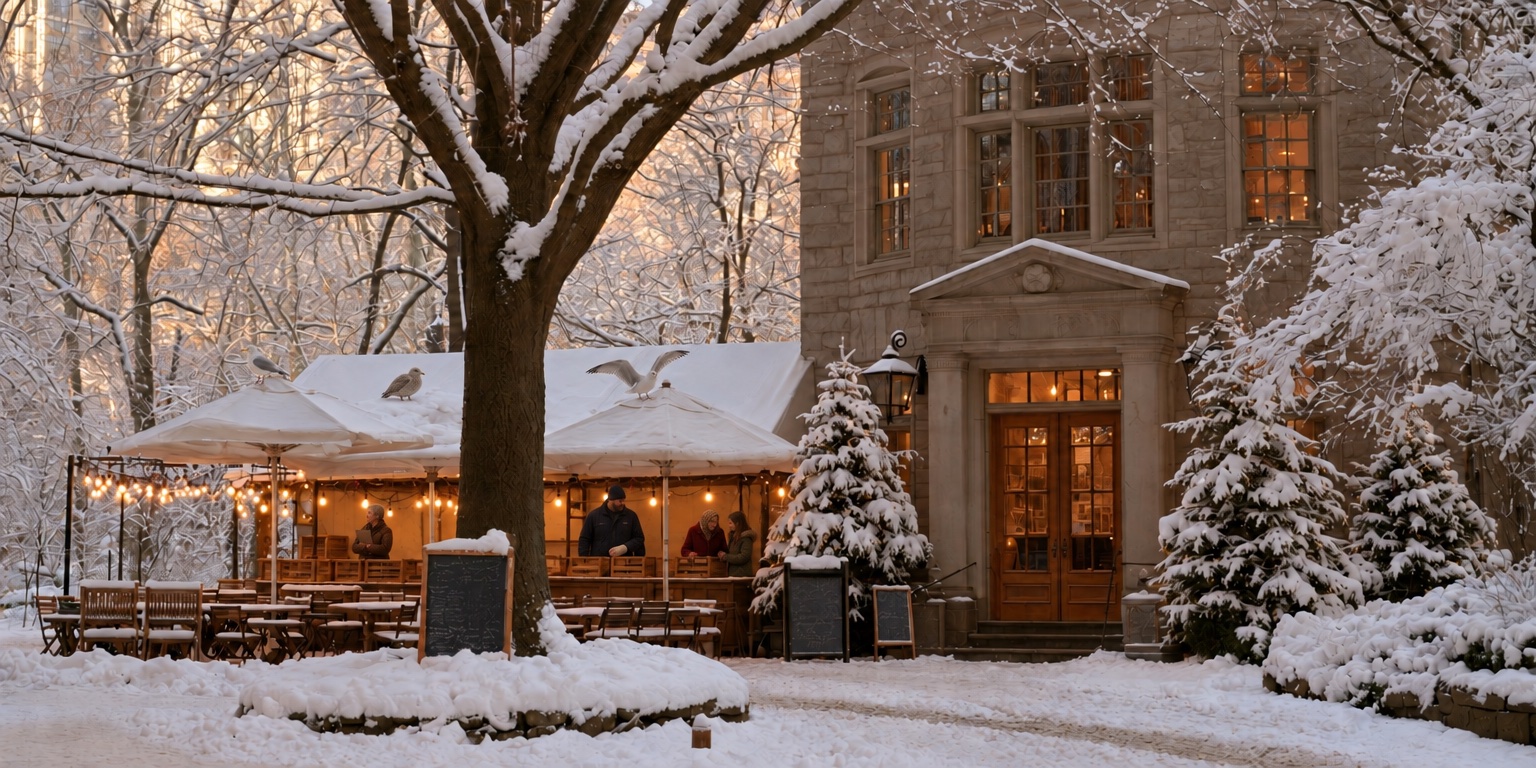
The morning came up hard and clear, eleven degrees, the kind of cold that makes the snow squeak like styrofoam and the flag halyards ring against their poles all down the shore. We were at posts by ten. I’ll say this once and then I’ll go back to being sensible. Nine lit stalls in an empty square, awnings out, boards chalked, lights on in the middle of the day, every one of us behind our counters with nothing on them, and the whole thing facing an audience of gulls. It looked like a memory the town was having with its eyes open. I stood at my post and my chest did something I put down to the cold.
They walked the aisle at eleven. That was the ceremony, that was all of it, Father Lindqvist waiting at the fountain end in his good coat being technically just a man. Greta and Einar came up the row the way customers come, slowly, stopping at every single stall, and at every stall the keeper stood at post and served them nothing, and it took half an hour, and it was the longest anyone has ever taken to buy nothing in the history of commerce, and nobody hurried them, and the wind behaved for exactly that half hour, which I am not going to make anything of.
At the fountain, the retired Father said the words, shorter than the walk. They kissed like people who had already been married thirty-one years and were just now getting the paperwork. The Ahn sisters rang the closing bell, which is the same as the opening bell, a bell doesn’t know.
Then they came to me.
I had the drawer open before they reached the counter, because if you’re going to do a thing you do it properly. Greta asked, in her market voice, carrying, formal, what I had today. I said not much, delivery’s expected, but I could do her a card of buttons. She said that would do fine, a card of buttons, for the mending, a marriage being mostly mending, and I did not look at Einar because one of us needed to hold the counter steady.
I sold her the buttons. Full price, spoken out loud, coin on the wood, change counted back into her glove, receipt from the winter book, the whole rite of it, and the square was so quiet you could hear the pencil. What I did not say, and what nobody but Signe would have caught, Signe caught it, is that the card I put in Greta’s hand was not off the rack. It was the brass ones. The old stock, the good ones, from the drawer that doesn’t sell, and if anyone asks, they were nearest the front, and that is my whole statement on the matter.
“Sold,” I said, and Signe, ninety-one, at post with her granddaughter holding her arm, said it after me like an amen, and the market was a market, and no ghost.
We had the soup outside, all of us, off the tailgates, steam going sideways, and then we folded the whole thing away before dark because weather was coming and because a thing like that shouldn’t stand around getting ordinary. Awnings down, crates nested, boards wiped, though I noticed more than one of us wiped around the chalk instead of through it, so that TODAY: NONE. ASK IN JUNE ghosted on Greta’s board for weeks, and my EXPECTED is faintly there yet, which in a dry goods shop is always true, so I’ve let it be.
By morning the snow had filled the square back in and you could not tell, and that was the point. The lights were coiled, the brackets greased against next time, Sten’s wrist in a shop bandage he wore like a medal. The insurance rider went in the book under miscellaneous, paid, never mind by whom. And the coin is in the till, the specific coin, I know it by the year, and it does not spend. It isn’t sentiment. It’s just that every time it comes up in the count, the count comes out one coin better than a February has any right to, and I find I run a tidier book knowing it’s in there.
A market happened. Nothing was for sale, one thing was sold, nobody came, and everybody stayed. Best day of trade I ever had.
I want it noted I voted no.
♥ 2026 Claire Jacobs · CC BY 4.0 · a story from Good Day Mockingbird № 6