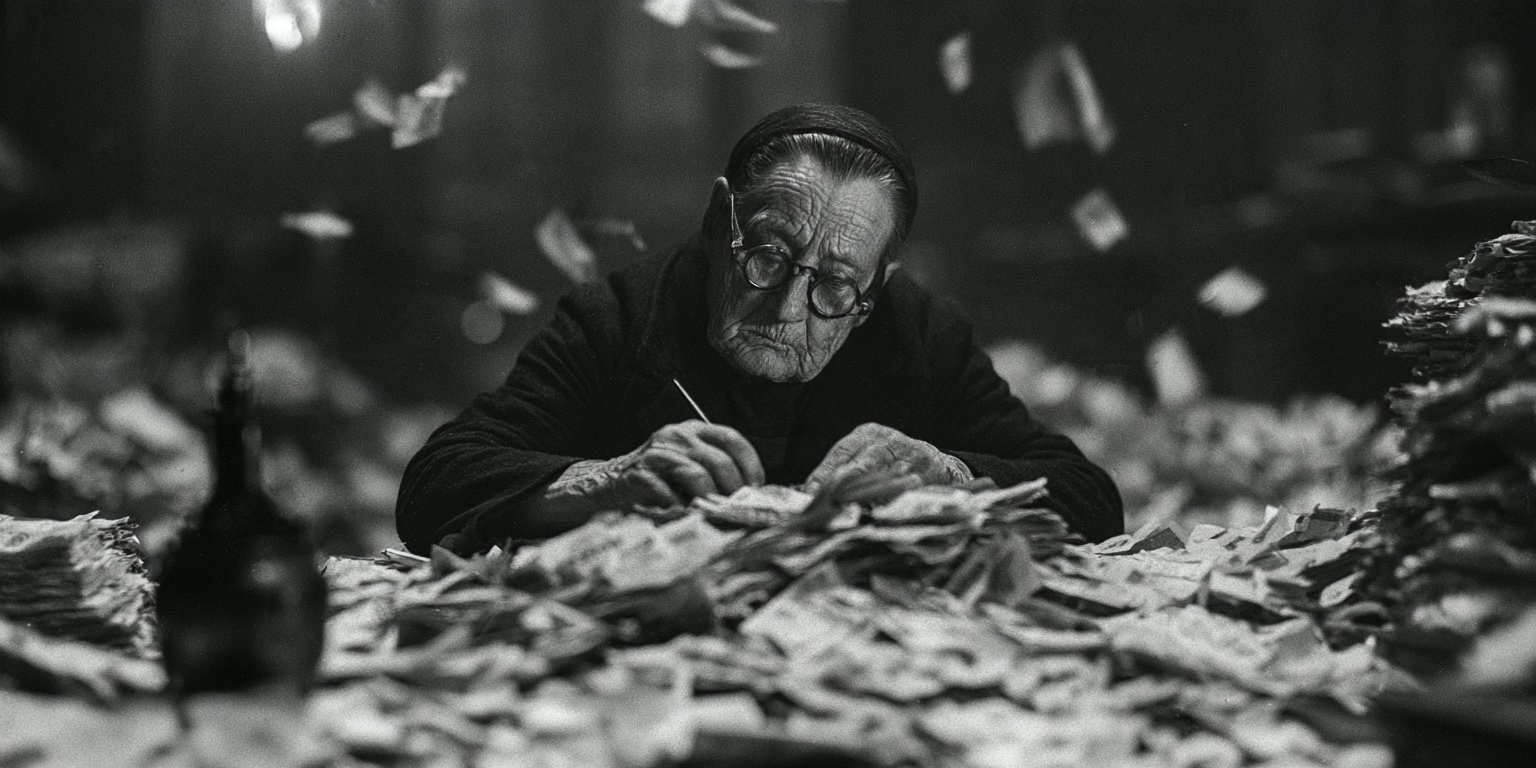
Issue № 9 · Story I
The Noon Rate
Obernfeld, autumn 1923. Grete Voss has chalked the mark’s rate since her husband fell at Verdun, and this October she wipes the slate at noon and again at four, and the four o’clock number has begun to frighten her. A Dutchman comes to buy the town’s pianos with guilders. Her old schoolmaster comes with the savings of a lifetime in a passbook. And the slate says what each of them is worth, until she counts her own bonds out loud.
The rate came up from Berlin on the noon wire, and by one minute past noon it was wrong. Grete Voss chalked it anyway, tall ciphers on the slate above the booth, because a posted number going publicly stale was still better than no number at all. That was the whole profession by that autumn. She sold arithmetic in a country where arithmetic had taken sick leave.
The booth stood at the mouth of the Obernfeld Tuesday market and had stood there since before the war, her husband’s first. Otto had changed francs and crowns for drovers and pilgrims and commercial travelers, a sleepy trade, a rate a week. He fell at Verdun in the summer of 1916 and she took the stool the same month, and for six years the work stayed small. Then the mark began to run, and then to bolt, and by the autumn of 1923 Grete Voss was the busiest woman in town and the least loved, which she understood to be one job and not two.
She changed paper marks into anything that would hold still. Dollars when she could get them, guilders, Swiss francs, the old silver five-mark pieces with the dead Kaiser on them, which had outlived the empire and were now outliving the money that replaced them. She changed the town’s emergency scrip, printed by the Rathaus on linen because paper was wanted for the real presses. And she changed it all back again for anyone fool or desperate enough to need paper, which was everyone, eventually, because bread was priced in paper even when the price had twelve zeros in it. Every crossing in town came past her window. The Ehrlich boy changing everything his family had into dollars for the Hamburg passage. The Kötter family changing silver to paper and back twice in one week around a funeral, because dying had two currencies that autumn like everything else. In the summer she had chalked the rate twice a week. By October she wiped the slate at noon and again at four, and the four o’clock number had begun to frighten her, and she had been seven years at the stool. By then the paper came to her window in bundles, and the bundles were counted by weight, a scale where a cash drawer used to be, because no one alive could count fast enough to keep up with what the presses were doing to the idea of counting.
The works paid out at noon on Tuesdays. The wives were at the fence by a quarter till, and the men passed the pay packets through the pickets without a word, and the women ran. Nobody laughed at the running. Lard at nine in the morning cost less than the same lard at five, and the difference was a child’s supper. The market had learned to move at the speed of its own prices, stalls repainting their boards between customers, and at the center of the whole sprint sat Grete with her chalk, the one woman in town paid to stand still.
Frau Pietsch went for her on the second Tuesday of November, in front of the booth, at full voice, with the queue watching. You and your slate, she said. You decide at noon whether my children eat by supper. You’re not a shop, you’re the weather, and you chalk it up there like God posting His intentions.
I don’t make the water rise, Grete said, loud enough for the whole queue, because an accusation heard by thirty people must be answered in front of thirty. I read the gauge. Somebody in this town has to read it out loud.
That was true. It was also true that she read the gauge before anyone else, and that a woman who reads the water first swims first, and both of those facts lived in the same apron. Her strongbox held guilders. Her coal was bought through February. She did not say any of that to Frau Pietsch, and she did not sleep well that night, and she opened the booth at eight the next market day because self-knowledge is not a business plan.
The Dutchman came at ten. Van Daal, a round, mild, freshly shaved man with a leather folder, in town for the third time that season. He was buying the Falkenhagen pianos, both of them, and the silver, and the linen press, and whatever else a dying house would uncrate for hard money. The sellers needed paper to live on and asked in paper, and so the guilders came to Grete to become paper, in bulk, at the window of a woman who had taken coffee in the Falkenhagen parlor as a girl. The elder Fräulein Falkenhagen had taught piano on the smaller of the two instruments to half the town’s daughters, Grete among them, four winters of scales with cold hands. Now the instrument was leaving town in a Dutch van at the price of a sound week’s groceries.
A marvelous country for the thrifty visitor, van Daal said pleasantly, while she counted.
She quoted him Friday’s rate. Three days stale, in that October, was a canyon; the spread disappeared some unspeakable number of millions, and he signed for it smiling, because a man wading in zeros cannot feel one canyon more, and because he assumed the little widow’s slate was the truth posted fresh. He was robbing the town with the town’s own arithmetic. She skimmed the robbery on its way through, and she did not pretend in her own book that it was anything but what it was. The entry said rate difference, which was the truest lie in the ledger. The spread went where spreads go, into coal, into the strongbox, into the winter. If van Daal ever learned the word for what she’d done, he could take his complaint to whichever God was handling the town’s other claims that year, and stand in the queue.
Herr Brandt came at one, and for him she stood up.
He had taught her sums in this town, thirty years of boys and girls, chalk on his cuffs the whole of her childhood, a Studienrat with a pension and a passbook and the good coat gone shiny at the elbows. He laid the passbook on her counter the way men his age laid things down that autumn, as if setting down a sleeping animal. The savings of a schoolmaster’s lifetime, 1892 to 1916, entry by entry in four different inks, and the war bonds folded inside the back cover, subscribed in the patriotic years at the urging of posters.
The bank clerks had laughed at a man like him the week before, in the next town over. She had heard about it. Everyone had heard about it.
Grete did not laugh. She opened the book and counted it through aloud, entry by entry, date and sum, in the reciting voice his own classroom had put into her thirty years of multiplication tables ago, and the queue behind him stood for it in something like church quiet, and it took a quarter of an hour, and when she reached the end she told him what thirty years came to at the noon rate, which was nothing. Not the tram fare home. Not the stamp to post the book to anyone who cared. She gave the nothing its full count, because he had not taught her to round.
Then she said: What I will do, Herr Brandt, is buy the book.
He looked at her.
Not change it. Buy it. The object, she said. When this is over, and it will be over, one way or the other way, men in clean coats who were never hungry will collect what this autumn printed. Passbooks. The linen scrip. The milliard notes. Curiosities fetch money the moment they stop being wounds, and I buy early. That’s the trade I’m in.
It is charity, he said, with the pride of a man who has nothing else left to pay with.
It is speculation, she said. I expect a profit, and I’d rather owe it to you than to a stranger. And she paid him for the passbook in old silver, one five-mark piece, the dead Kaiser face up on the counter, the oldest money in town buying the deadest, and Herr Brandt took it the way a man takes change, not alms, which was the entire point of the lie, if it was one. She filed the passbook in the strongbox, under the guilders.
It lay there, after that, directly on top of her own.
Because Grete Voss also had a folder of war bonds, subscribed in the black month of 1916, the month of the telegram, when the posters on the church wall said the fifth loan would finish what Otto was already inside of, and a widow wants the war that has her husband to be worth finishing. She had carried those bonds through every rate she had ever chalked. She knew to the hour what they were worth. She was the one woman in town with no excuse not to know, and she had never once counted them out loud.
On the last paper Tuesday in November she did it at her own window, to no customer at all.
She read her own bonds through in the reciting voice, date and sum, posted rate, full count, the market going about its business in front of her, and entered the conversion in the book in her best hand, and took from the drawer what a widow’s patriotism came to at noon that day, and walked two stalls down to Frau Hänsel, who boiled eggs on market days for men who had stopped trusting bread.
One egg. That was the rate, and she had set it herself, and the rate is the rate.
She ate it standing at the booth, shell in her apron pocket, and wrote the last line of the entry while the taste was still in her mouth. War loan, 1916. Converted. Proceeds, one egg, eaten. She did not buy her own bonds back as curiosities, though the drawer held silver enough. Mercy through a loophole was a rate she offered at the window. She had never once offered it to the woman behind the counter, and it was too late in the autumn to start extending credit of that kind.
The new money came in the middle of the month, backed, said the papers, by land and rye, which as far as Grete could tell meant backed by the country’s agreement to stop. A trillion of the old made one of the new. The queues at her window went strange for a week, then thin. Prices stood overnight like horses gone suddenly tame, and people walked the Tuesday market touching the boards, reading numbers that had not moved since breakfast, not trusting the stillness, the way you walk a floor that has stopped pitching.
On the first Tuesday of the Rentenmark, Grete chalked the noon rate, and at four o’clock it was still true. She stood behind a true number for the first time in two years with nothing to do with her hands. Frau Pietsch passed the booth with her basket and nodded, a nod with no weather in it, which from Frau Pietsch was a treaty. Herr Brandt crossed the square and bought half an ounce of tobacco with coins, coins that would still be worth tobacco on Friday, and she watched him count them, for the pleasure of it. Toward dusk the egg shell went from her apron pocket into the brazier, and the old slate kept its number.
She left the rate up overnight, which Otto would never have allowed. In the morning it was still right. She wiped it anyway and wrote it fresh, the same ciphers in the same hand, for no reason a customer would ever see. To feel it once, after the autumn: the chalk and the world, agreeing.
♥ 2026 Claire Jacobs · CC BY 4.0 · a story from Good Day Mockingbird № 9