Issue № 11 · Story II
Even
Everyone at the City Market loves Gene Prewitt, who gives every employee a turkey with their name on the tag in his own hand. Tess Looby has run his tills for eight years, and when a sixteen-year-old runner asks her why his first stub is two hours short, she goes home and does her shoebox: the clock that rounds like a man owed money, the pay that runs bell to bell, the shortage deductions. Two thousand nine hundred dollars. She takes the number to nobody. She opens a notebook instead, ruled like a wage book, and starts counting down.
Everyone at the City Market loved Gene Prewitt, and the honest place to start is that Tess Looby loved him too. Eight years on his tills, produce mostly, fish when they were short, and in eight years he had never once failed to say her name like good news. Prewitt’s ran five stalls under the market’s iron roof and had since his father: produce, fish, the deli, flowers, and the coffee counter where he held court. He gave turkeys at Thanksgiving, every employee, every year, with your name on a tag in his own handwriting. He gave the first-day-of-school pencils, the funeral flowers, the rent loan nobody was ever hounded for. He cried at retirements, real tears. The market called him the last of something, and meant it as praise, and never asked the price of the something, and neither did Tess, for eight years. The rent loans were the masterpiece. He never asked for them back, and he never let you forget he hadn’t, not with words, with the squeeze on the shoulder every payday after, and half the floor owed him something that had no due date, which is the strongest kind of owing there is.
The paystubs came folded in thirds, every Friday, from the office upstairs where Gene’s son-in-law Kevin ran the numbers. Tess kept hers in a shoebox, out of some inherited thrift, unexamined. That was the whole mechanism of it, she decided later. Prewitt’s didn’t hide the arithmetic. It just made you feel small for doing any.
The new kid broke it open. Tomás, sixteen, produce runner, first job, holding his first stub like a diploma that October, and he asked her, because she was kind to him and ran the till like weather, why it said he’d worked thirty-one hours when he’d worked thirty-three. Tess looked. The clock at Prewitt’s rounded to the quarter hour, and it rounded like a man owed money. Clock in at 6:52, it wrote 7:00. Clock out at 3:11, it wrote 3:00. And everyone was in by quarter till because Gene liked the cases dressed before the bell, and the bell was when the pay started, because pay was bell to bell, because that was how Gene’s father had done it, and nobody had ever once called it what it was.
She went home and did her shoebox. All of it, eight years, a calculator and a kitchen table and the radio off. The rounding, the quarter-tills, the till-shortage deductions that came out of clerks’ checks whenever the office’s count disagreed with the drawer, and the office’s count was scripture. Small amounts. Polite amounts. Never enough in any one week to fight about, which she came to understand was the design, or worse, wasn’t a design at all, just a machine so old nobody had to run it. Her number, when she had it, reconstructing what she couldn’t prove at the low end, was two thousand nine hundred dollars.
She took the number to nobody. That was a decision and she knew its name. She was fifty-one, the job was the job, the market was full of Kevins and short on Genes, and Phyllis at the deli, who had been there thirty years, said what Phyllis always said when the clock came up, which was that you don’t weigh a man like Gene on a kitchen scale. So the complaint died where complaints at Prewitt’s died, in the deciding not to. What began instead, the Monday after, was the notebook.
She ruled it like a wage book, because fair is fair. Date, amount, running balance, starting at two thousand nine hundred and counting down. And she set herself rules, because she had watched honest systems her whole life and knew that what made them honest was never the honesty, it was the limits. Cash sales only, during rush, rung as no-sale, the bill folded into her apron with dry hands and a still face. Never more in a day than the clock stole in a week. Never on inventory days. Never when Tomás shared her shift, because if the count ever went wrong on a shared day, the office charged the drawer, and the drawer had two names on it. Never from the tip jar, which belonged to the floor, not to Gene. She kept her own counts to the penny and wrote them down the same night, and if you had told her she was now the second crooked bookkeeper in the building she’d have corrected you. Second bookkeeper. First honest one. She liked the joke enough to be careful who heard it, which was nobody. Secrecy agreed with her more than she expected. That was another item she filed for later, and later kept not coming.
It went thirteen months. She was good at it the first week and better after, and the being good at it was a problem she filed for later. There were mornings the fold of a twenty into the apron felt less like theft than like the only part of the day where the arithmetic ran her direction, and she noticed that feeling, and noticed herself looking forward to it, and wrote the amounts down anyway, to the penny, while the balance walked down through two thousand, through one, through the hundreds, like a man coming home.
On the Tuesday before Thanksgiving she wrote 0.00 in the right-hand column. At close that night Gene handed her a turkey with her name in his own hand on the tag, and squeezed her shoulder, and said she was the spine of the place. She rode the bus home with the bird on her lap and the zero in her pocket, and the two should have balanced, and did not, and that was the first she knew of the trouble she was in.
Because even didn’t hold.
She had promised herself the line and reached the line, and the line turned out to be painted on water. The next week she opened a fresh page and wrote Interest, and backfigured eight years at a savings rate, and the week after that she wrote Saturdays, 2016 to 2018, the mandatory pre-bell staff meetings nobody had ever been paid for, defensible, arguable, real. Then the entries began arriving after the taking instead of before it. For the parking they promised and gave to the fish trucks. For my girls, which is what Gene called the tills, sixty years old some of my girls, for the tone of it, for eight years of the tone of it. She watched her own handwriting price things that did not have prices, testimony dressed as arithmetic, and she knew what she was watching, and kept the pen moving. Twice she skipped the pen entirely and caught herself days later trying to remember an amount, and the forgetting frightened her more than the taking ever had, because the counting was the last thing in it she could still call hers. She had crossed from collecting a debt into billing a life, and the one thing she could not find anywhere in the notebook, though she looked, was the entry that said enough.
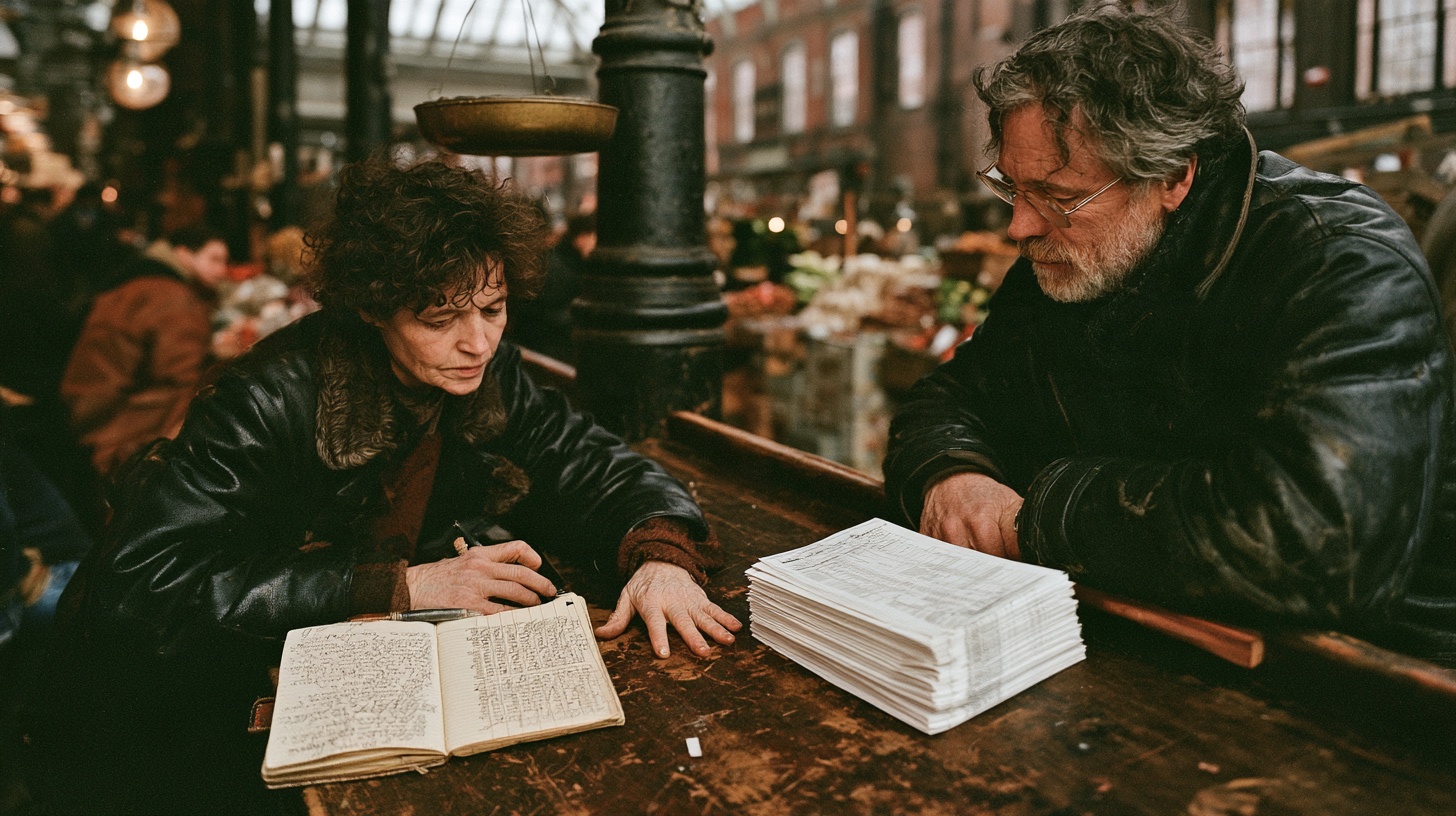
The drawer caught it before her conscience did. In February the office flagged a Thursday, a shift-change Thursday, her rush running long into Tomás’s clock-in, forty dollars light by Kevin’s count, and the drawer had two names on it, and the office charged the kid. Standard practice. Half from each check until made good, and a note in his file, and Gene came down himself to do the sorrow, hand on the boy’s shoulder, nobody’s angry, son, but a till is a trust. The kid stood there with his face fighting itself, taking the sorrow of a man he worshipped for a thing he didn’t do, apologizing for it, and Tess watched exactly one week of that before she went upstairs on a Friday with the notebook and the shoebox and asked for Gene at the long table, and said it loud enough that asking for privacy afterward would be a joke.
She put her book next to Kevin’s printouts and said, that Thursday is mine. And then, since the room was already stopped: so is this, and she read it, dates and amounts, hers and his both, the twelve minutes and the quarter-tills and the shortage deductions down one side, the no-sales down the other, two accounts of the same eight years, kept to the same penny, and whose was uglier was suddenly a live question at a table where no question had been live in decades.
Gene did not yell. He went red and quiet and then he said the thing he had instead of a defense, which was true, which was the trouble with it. I have fed this market’s families for thirty years. Nobody ever left my stalls hungry.
Nobody left hungry, Gene. We left short. Loud, over the prep table, with the deli line listening through the floor. You fed us with one hand and clipped us with the other, twelve minutes at a time, and you want the turkey remembered and the minutes forgotten, and until this book, nowhere in this building were both of them written down.
Kevin, who could read a column faster than anyone in the family, had been reading hers. He put his finger on the fresh pages and did the only damage that stuck. You passed even in November of last year, he said. By my count you’re two hundred and forty dollars past it and writing poetry in the margins. Which of you is the thief today, exactly?
Both, she said. It was the only sum left that checked. Both, and only one of us came up here and said so.
Nobody called anybody’s lawyer, and nobody called it forgiveness either. What happened was colder and more honest than both: two photographs of two books, his of hers, hers of his, like a prisoner exchange, mutually assured arithmetic. Kevin kept her notebook’s last pages the longest, reading the margins twice. Tomás’s docked pay came back in his next envelope with a twenty on top, because Gene’s instincts for theater survived anything. Tess’s keys did not survive the week, and she didn’t ask them to. Phyllis wouldn’t look at her, and said so, out loud, in front of the flowers: some things you don’t do to a man who gave you turkeys. That sentence followed Tess out of the building, and the worst part of it, she thought on the bus, was that Phyllis believed it, and the turkey man believed it, and eight years ago she would have believed it too, and none of the believing changed one entry in either book.
The January after, with no announcement, the clocks at Prewitt’s stopped leaning. In by quarter till still, but the pay ran from the punch, not the bell. Nobody was told. The fix arrived the same polite, structural, deniable size as the theft had been, the empire adjusting to protect the empire, and the only people who’d ever know were the ones who did arithmetic, which, as Tess could have told them, is how the whole thing stayed up in the first place.
She counts a drawer at the hospital cafeteria now. Correct stubs, printed clean, direct deposit offered and declined, because she likes to hold it. The first Friday she checked the math and it was right, and she checked it again, and it was right, and she sat in her car and checked it a third time and understood that this was permanent, that the checking had moved in for good, that he had taken one more thing off her that never made either book.
♥ 2026 Claire Jacobs · CC BY 4.0 · a story from Good Day Mockingbird № 11