Issue № 11 · Story I
Six Months
Tokyo, the market under the Ueno tracks, the Monday after the Games opened. Ōhashi logged other people’s lost things for the railway for sixteen years, and now he walks the market looking at the ground. What he finds he hands in at the police box, every time, because the law gives an unclaimed thing to its finder six months after the notice goes up, and a tenth of its worth if the owner comes. Under the squid stall’s crates there is a bank envelope, thick, with no name on it. He writes two dates in his notebook. Then, three days before the second one, a woman in a dark coat comes to the window with a paper from the police station. A thief by every rule but the one the law wrote.
Tokyo, the Ameyoko market under the Ueno tracks, October 1964, and the April after.
Ōhashi came into the market from the station end at nine, when the stalls were open and the crowd was not yet in, and looked at the ground.
He had looked at other people’s lost things for a living for sixteen years. The found-articles room at Ueno Station was under the platforms and had no window, and what came down to it came in sacks off the Tōhoku trains: umbrellas by the hundred, one glove at a time, schoolbags, a set of teeth in a handkerchief, and, two or three times a month, an envelope of money that somebody’s son had been sent to Tokyo with. He had logged all of it on the same ruled form. The umbrellas nobody came for. The teeth, somebody always did. Money came back to its owner by the third day or it did not come back at all, and by the second day he could usually say which, from whether the envelope had a name on it.
The office had been reorganized the year before and he had been let go at fifty with a sum that lasted a year. He was fifty-one now. He had the form by heart and a notebook ruled to match it.
The market ran along the west side of the tracks from the station down to Okachimachi, five hundred metres of stalls under tin and tarpaulin, and the trains went over it every few minutes and dripped. Dried squid, dried mushroom, candy by the scoop, nylons, cosmetics, canned fruit with American labels, salt salmon on ice, watches on velvet under a bulb. He did not look at any of it. He looked at the strip where the drip fell and the wood went soft; at the dark under the crate stacks, where a thing kicked once stays kicked; at the drain grates, which took coins and nothing else.
Mondays were good. Saturday was the market’s day, and on Sunday the keepers swept what they could see. That October, the city was full of people who did not know where they were walking.
At the squid stall the keeper was pushing his crates back against the wall with the side of his foot, not looking down. Ōhashi waited until he had gone round to the front. Where the last crate had been there was a bank envelope flat against the wall, the brown kind with the bank’s name in a circle, and it was thick. He put it in the cloth bag without opening it. He had handled envelopes since 1947. He knew a month of somebody’s wages by the hand.
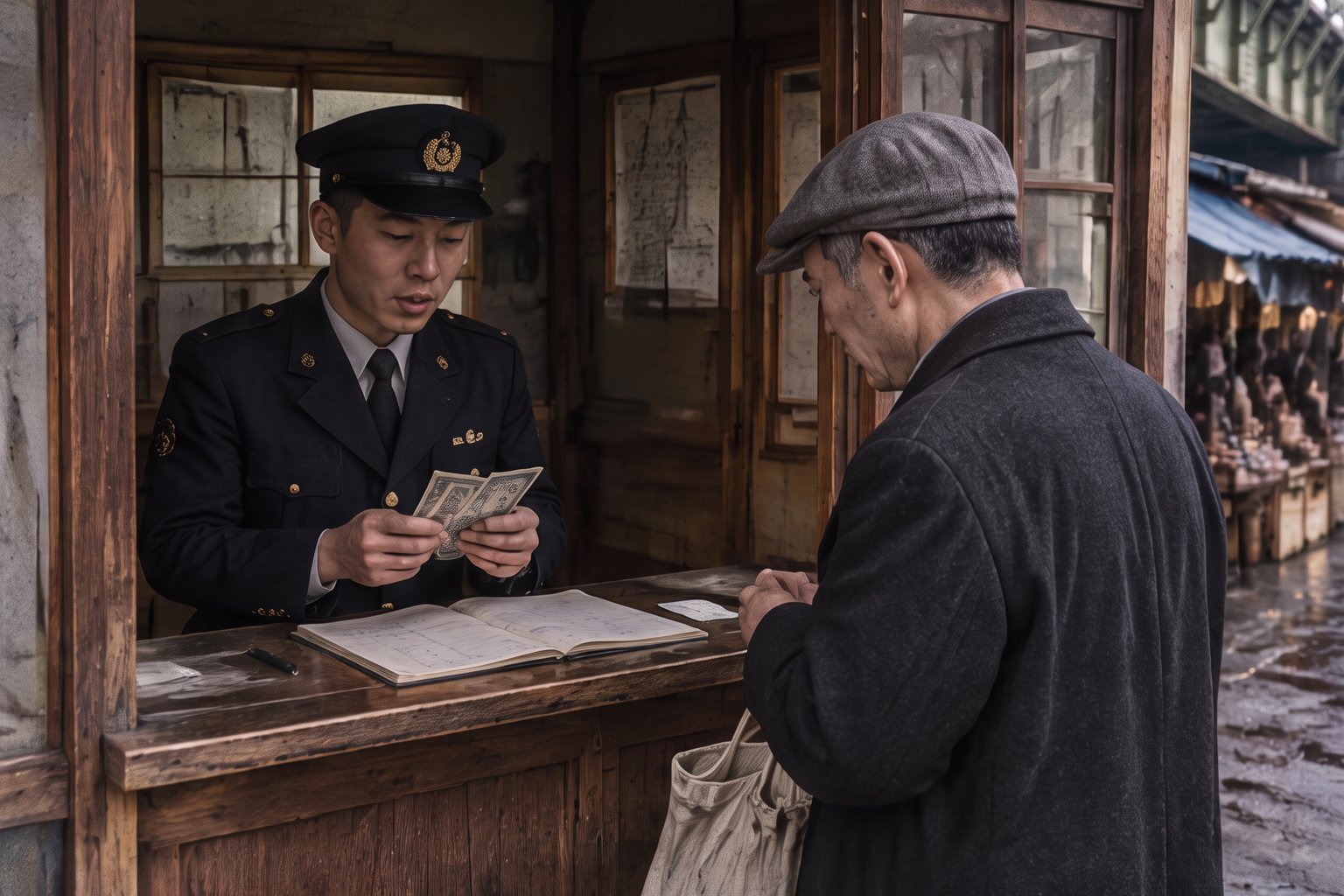
The police box was at the station end where the market met the street, a two-man box with a counter, a stool, a telephone and the ledger. Officer Mori was in it alone. He was twenty-four and had been there two years, and somewhere in the second year he had stopped asking Ōhashi where he had been standing when the thing fell.
“Morning. Umbrella?”
“Envelope.” Ōhashi put it on the counter.
Mori opened it and counted, out loud, in the new thousand-yen notes. Thirty. He counted them again and got thirty. Then he took the pad of receipts and wrote: the date, the place, the thing, the finder’s name and address. Mori tore the receipt along the perforation and gave him the stub, and opened the ledger and wrote it all again on the next line, and the line had a number.
“Where?”
“Under the squid.”
“Under the squid,” Mori said, writing. “No name.”
“No.”
“They’ll come for this one.”
“By Thursday,” Ōhashi said. “Or not.”
“The notice goes up tomorrow.”
“Tomorrow, then.”
He took out his notebook. It was ruled in two columns in his own hand. In the left he wrote 12 October. In the right he wrote 13 April, and under it, smaller, to 13 June.
The law was not long and he had worked beside it for sixteen years. A thing found and handed to the police was the finder’s, six months after the police gave notice of it, if nobody came. When somebody came, he or she owed the finder between a twentieth and a fifth of what the thing was worth, and the finder had a month to ask. A finder who kept a thing more than seven days before handing it in had nothing coming, ever. A finder who did not collect what was his within two months of its becoming his, lost it to the prefecture. Those were the four numbers. Six; five to twenty; seven; two. He had never used more than one of the seven days, and he had missed the two months once, on purpose.
In the year since the station let him go, the rule had given him sixty-three umbrellas; four single gloves (never a pair); a cigarette lighter that worked and a fountain pen that did not; a pair of reading glasses nearly his prescription; two thousand three hundred and seventy yen in small money, in nine amounts, whose owners had not thought the trip worth it; and a child’s shoe, which he had let go to the prefecture because he could not think what it was for. The umbrellas he sold to the umbrella stall at the Okachimachi end for thirty yen each. The umbrella stall sold them under the tracks for a hundred and fifty to people who had come out without one, and a few of those he had back inside the month.
“You’re writing it in your book,” Mori said.
“Because it’s in your book.”
“Yes, but my book is the one the station reads.”
“That’s why I write it in mine,” Ōhashi said, and put the stub between the pages.
Nobody came by Thursday. He knew by Wednesday night. Thirty thousand yen with no name on it is lost by somebody who does not know where, and a person who does not know where does not come to the police box under the tracks.
In November the market began to fill with the year-end crowd, and by the last week of December you could not see the ground for the people on it, four days running, and he did not walk it. He sat in his room in Shitaya, four and a half mats of floor space, and did his book. In January he asked Mori to look at the ledger, and Mori looked at it with his back to him, and the line was open. He did the sum once, for the room, and put the notebook away.
She came on a Saturday in April at ten, when there were two people at the window ahead of her, a man asking where the park was and a girl with a purse that was not hers. Ōhashi stood at the end of the counter with an umbrella, waiting his turn. She was in a dark coat that had come a long way on a train, and she held her bag in front of her with both hands, and she had a paper from the police station.
Mori read it. “Ōhashi-san,” he said. “This one’s for you.”
She looked at the paper and then at him. “The station said the finder would be here.”
“I’m the finder.”
“They said you would be.” She looked at him for a while, and then at the umbrella, and then at the floor of the box. “It was that Saturday. The tenth. The day it opened. We came down for a sewing machine. I had it in my bag at the station. I had it at the station and I did not have it at the shop. We went home on the Sunday. My husband wrote in November, and in December they wrote back that it was here, and that I had to come myself. I came when there was money for the train.”
“Yes,” Ōhashi said.
“The station gave it to me this morning.” She did not take the envelope out of the bag. “They said there is a reward.”
“The law says between five and twenty parts in a hundred,” Mori said. “It’s between the two of you. The police don’t take part.”
“He picked it up,” she said. Not to Ōhashi.
“He handed it in,” Mori said. “Yes.”
“That is what he did.”
“Yes.”
“Then the five.”
Ōhashi said, “Ten is what people pay.”
“Five is what it says.”
She opened the bag and counted onto the counter, in the new notes and in coin, fifteen hundred yen, and squared the notes with her finger.
Ōhashi did not pick it up. He said it to the box, and the man who wanted the park and the girl with the purse heard it. “Three thousand is a tenth. Fifteen hundred is a twentieth. From the thirteenth of October to today is a hundred and seventy-nine days. I came past this window on every one of them. On Tuesday it was mine. I had it on this counter inside the hour, with my name on the form and my address. A thief does not do that. A thief leaves it under the squid for a week, and then it is nobody’s.”
“A man who walks a market looking at the ground,” she said. It was not a question and she did not finish it. “Five is what it says.”
“Five is what it says,” Mori said.
Nobody said anything. The man who wanted the park went away without it. Ōhashi picked up the fifteen hundred yen and put it in his coat, the notes in one pocket and the coin in the other, and Mori wrote in the ledger, on the line with the number, received, one thousand five hundred, and the date, and she put her seal to it, and Ōhashi put his.
“Thank you,” she said to Mori, and went out into the market with her bag in front of her, as she had come.
“The stub,” Mori said.
Ōhashi found it in the notebook between the October pages and gave it to him. Mori pinned it to the ledger with the others. Then he took the ruler from under the counter and laid it along the line, and drew through it, from the date at one end to the date at the other.
♥ 2026 Pete Kaminski · CC BY 4.0 · a story from Good Day Mockingbird № 11