Issue № 7 · Story II
The Raised Letters
October 1986. The city dedicates a bronze plaque on the new boardwalk, and it says the rock’s famous arch fell in 1906. Rose Bettencourt watched it fall three winters ago, from the seawall, in rubber boots. Recasting costs four thousand dollars. A counter rag costs nothing.
The city dedicated the plaque on a Saturday in October, which meant the sea lions were massed on the Ledge and in full voice, and the whole ceremony had to be conducted over the barking. The man from Parks kept pausing at his microphone to let a swell of it pass, the way you’d wait out a train, and three hundred meters offshore Penny Rock sat with its two horns and its gap against a bright sea and outshouted him without trying.
Rose Bettencourt watched from the door of her chowder stand with a rag over her shoulder. She had a good view. The new boardwalk ran the length of the old cannery yard, seawall, railing, coin-op binoculars at intervals like parking meters aimed at the sea lions, the taffy shop in its first coat of paint, and her stand at the west end with the Lupe’s bell hung over the door, salvaged off the schooner that broke on the Fist in 1874 and passed down the cove ever since, lookout to cannery to her. Dedication day had brought out half the town and two busloads besides. The market ground was a market again, her mother would have said. It was selling salt water taffy, chowder in a bread bowl, and the view, and the view was moving briskly.
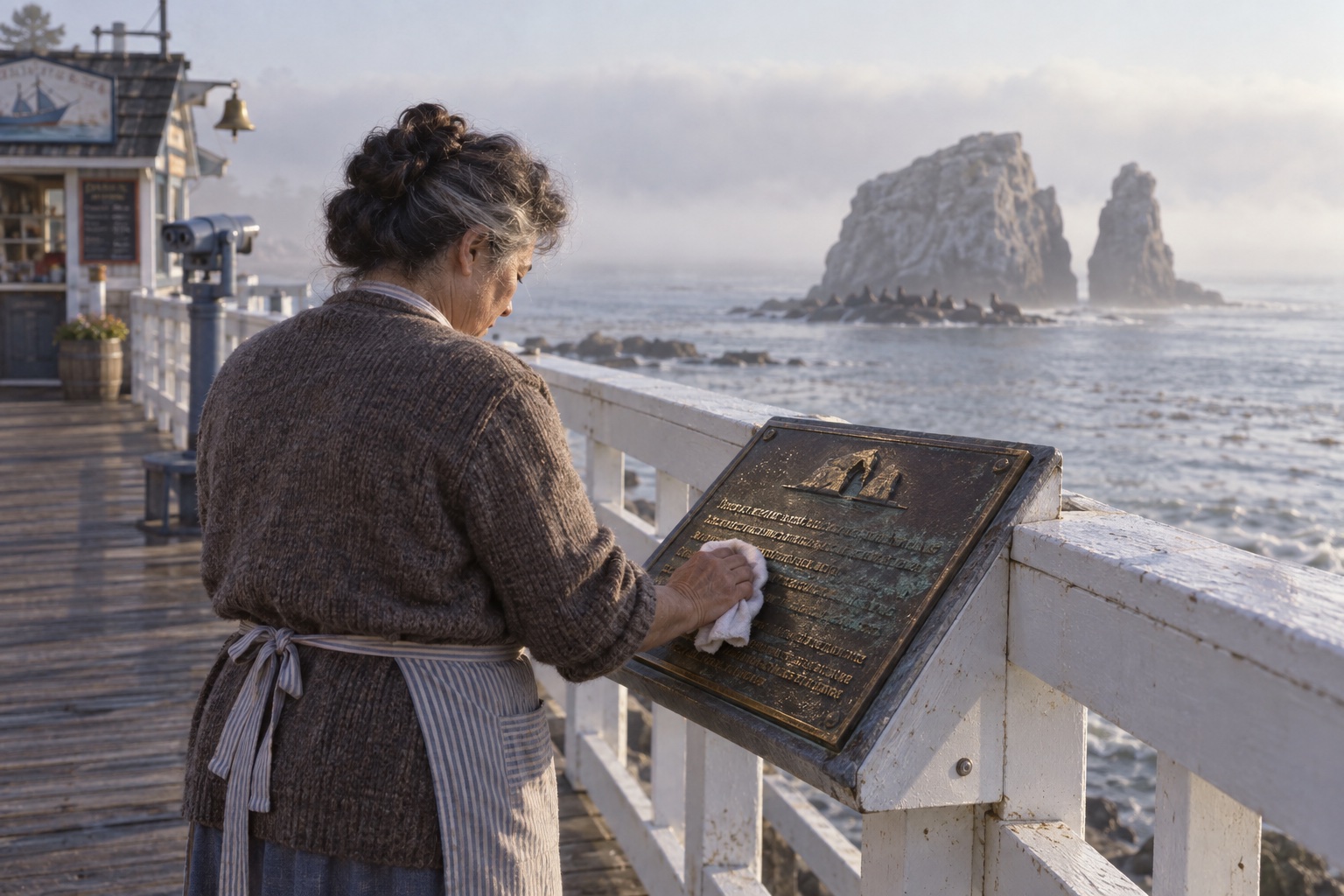
The plaque stood at the center of the railing under a little cloth. Cast bronze, they’d said at the council meeting. Raised letters. Built to outlast us all.
Rose was fifty-eight and had lived on this cove her whole life, which on this cove was not a distinction, but her family went back further than most of what the plaque was about to say. Her great-grandfather had come from the Azores to the whaling station on the west point, and it was whalers, his crew, who first painted the white stripe on the point in the 1860s, lined up on the Eye, so the lookout could call bearings to the boats. Her father had repainted the same stripe for the Penny Cove Packing Company in the twenties, for wages, over his own grandfather’s mark. She had the photograph behind her register: four men, a plank scaffold, the stripe half done, the Eye behind them with the sun coming through it.
And she had been on the seawall at dawn in late January of 1983, three winters ago, with most of the cove, after the night the storm took the Eye. Nobody had slept. The surf had been coming over the wall all night and booming in the arch like a door slammed somewhere in the house, and at first light the rain thinned and the whole town stood in rubber boots and looked out at a silhouette nobody alive had ever seen. Two horns. A gap. The rock with its mouth open. The sea around it was wild, brown with sand, and pieces of the arch were down under the foam, a roof that had stood since before the missions, gone between one wave and the next. Old Mr. Freitas had cried, and some kids had cheered, and Rose had stood with her coffee going cold and understood that she was now one of the people who remembered the other rock, and that this was a kind of promotion nobody asks for.
So she was maybe the wrong person, or exactly the right one, to be standing closest when the man from Parks pulled the cloth.
The bronze was handsome. She’d give them that. Raised border, raised letters, a little relief of the rock at the top. And the relief showed the Eye. The old silhouette, the arch you could see sky through, three years gone, shining up there in new bronze above the actual rock, which sat in the actual sea behind it with its actual gap, barking.
She read the text while the crowd applauded the general idea of history.
PENNY ROCK, it said, NAMED “LA PEÑA DE LOS LOBOS” BY SPANISH EXPLORERS FOR THE SEA LIONS WHICH HAVE MADE IT THEIR HOME SINCE TIME IMMEMORIAL. So far, fine. ITS FAMOUS NATURAL ARCH, “THE EYE,” COLLAPSED IN THE GREAT EARTHQUAKE OF 1906.
Rose read that sentence twice, then looked at the rock, which had lost the Eye on a January night in 1983 in front of the entire assembled cove, and then looked around at her neighbors, two hundred eyewitnesses in windbreakers, applauding.
THE WHITE MARK ON THE POINT, the bronze went on, WAS PAINTED BY THE PENNY COVE PACKING COMPANY TO GUIDE ITS SARDINE FLEET HOME.
Which is how Rose Bettencourt came to spend her town’s proudest morning in years standing at a railing while a plaque robbed her great-grandfather in raised letters, and misplaced a catastrophe she had personally watched by seventy-seven years, and instructed her, at the bottom, PLEASE DO NOT DISTURB THE MARINE MAMMALS.
She found the man from Parks at the taffy end afterward. His name was Pruett and he was not a bad man; he had the look of somebody who administers other people’s enthusiasms for a living.
“The Eye fell in eighty-three,” she said. “January. Half this crowd was standing right here in the rain. And the stripe was whaler work before the cannery ever touched it. My family’s, both times. I’ve got the photograph.”
Pruett nodded along like a man agreeing his way toward a door. The pattern for the relief had been drawn up years ago, he explained, before the storms, an artist down in Carmel, and nobody had budgeted to redo it. As for the text, the text had come from a history file, he couldn’t say whose. “Bronze is cast, Mrs. Bettencourt. It’s not a chalkboard. Recasting is four thousand dollars and a new fiscal year.” He brightened, having found the door. “What I can offer is a supplemental placard. Laminated. We could have Print Services do it by spring.”
“A laminated correction,” Rose said. “Zip-tied under the bronze.”
“Weatherproof,” said Pruett.
The crowd, it should be said, did not care. That was the part she chewed on all afternoon while the chowder line ran long. Tourists read the plaque out loud to each other, photographed each other beside it, dropped quarters in the binoculars, and moved along the railing perfectly happy. A man from Fresno told his son the arch fell in the big quake of ought-six, same one that burned Frisco, and the boy looked at the gap with his mouth open, and the wrong version did its work fine. The market had never needed the story true. It needed it short, and datable, and over by lunch.
The one correction that did get made that fall made the bronze harder to forgive. Down the boardwalk, the fenced remnant of the shell mound got its own sign, painted board, county budget, and the draft had gone for review to the Rumsen descendants’ committee, who sent it back with the wording changed in three places, and the county changed it, because repainting a board costs nothing. Rose stood in front of the finished sign for a while. So the town could correct itself, when correcting was cheap. Truth on this boardwalk was a materials question. Paint could afford it; bronze could not.
She thought about the four thousand dollars for about a week. She had it. It was the roof fund. She thought about letters to the editor, and about the council’s public comment period, three minutes at a microphone under fluorescent light, and she knew exactly how far a woman with a chowder ladle and a family photograph would get against a line item.
Then she did what her people had always done on that ground, which was set up a stall.
Not a real one. A practice. It started the following Saturday, when a couple from Sacramento read the plaque and wandered into her line, and the wife said what a shame they’d missed the arch by eighty years, and Rose, filling their bread bowls, said, “Three years. You missed it by three years. I watched it fall from that railing. Ask anybody in this line over forty.” And she told it. The booming in the dark, the boots at dawn, Mr. Freitas crying, the kids cheering, the sun going down through the Gap the next midsummer, wider and less exact, like the rock had loosened its aim. The couple stood holding their chowder like it was the good china. They came back the next day with another couple and pointed at Rose the way you point at a landmark.
By spring it was simply how the cove worked. The plaque sold the short version for free, and the long version was available at the west end of the boardwalk for the price of a bowl of chowder, no purchase technically necessary but nobody had ever tested it. Kids from the high school sent their out-of-town cousins to her as a rite. A docent from the new aquarium down the shore started ending her tide-pool walks at Rose’s counter and saying, “And this is the primary source.” The Lupe’s bell got rung for birthdays and, lately, for anyone who could recite the true date of the Eye unprompted. Pruett’s laminated placard arrived in April, was zip-tied under the bronze, and lasted eleven days in the salt wind, which everyone including Pruett agreed was about right.
Reyes, the young clerk from the city office, took to eating lunch at the stand on Fridays. She kept a folder. “For the file,” she’d say, writing down the stripe photograph’s date, the names of the whaling crew, the January night. “When the recast comes up, and someday it will, somebody in my chair is going to need all this in one place.” Rose fed her extra oyster crackers on the theory that the future should be kept fond of you.
But the thing people noticed, in the end, the thing that outlasted her, was the rag.
Rose polished the plaque. Had from the first month. Every morning before the fog burned off she came down the boardwalk with the counter rag and worked the raised letters, and she was not indiscriminate about it. PENNY ROCK went bright. LA PEÑA DE LOS LOBOS went bright, and the sea lions’ whole true sentence with it. PLEASE DO NOT DISTURB THE MARINE MAMMALS gleamed like a commandment. And the sentence about 1906, and the sentence about the packing company, she never touched, and the salt air did what salt air does, so that within a few years the plaque had gone two-toned, gold where it told the truth and sea-green where it didn’t, and you could stand at the railing and read the bronze’s own conscience at a glance, if you knew. The tourists thought it was wear. The cove knew it was an edit. Kids grew up on it. One girl traced the green sentences every visit, mouthing them, and Rose never explained, because the plaque was doing the teaching now, both halves of it.
Nobody at the city ever worked out who was doing it, or nobody tried very hard, Reyes having some influence over which mysteries got files. And on October mornings, when the barking came across the water so loud that the whole boardwalk had to talk over it, Rose would finish the letters, straighten up, and look out at the rock, two horns and a gap, no eye and no earthquake, getting every detail of itself exactly right for anyone who cared to check, the one account on that railing that had never once needed correcting.
She figured the bronze would outlast her, and the green would outlast the bronze’s pride, and someday somebody would run a thumb over the dull sentences and the bright ones and ask the right question. The answer would be waiting at the west end of the boardwalk, where there had always been a stall, selling what the place actually had in stock. The view. The water. The long version, ladled hot.
♥ 2026 Claire Jacobs · CC BY 4.0 · a story from Good Day Mockingbird № 7