Issue № 7 · Story I
The Tally-Woman
Monterey Bay, around 1180. At the last market before the winter storms close the coast path, the woman who keeps the spring keeps the accounts too, in her head, for everyone. A man asks her to declare him clear so he can stand surety for his son’s wedding, and she remembers a boat.
Monterey Bay, circa 1180
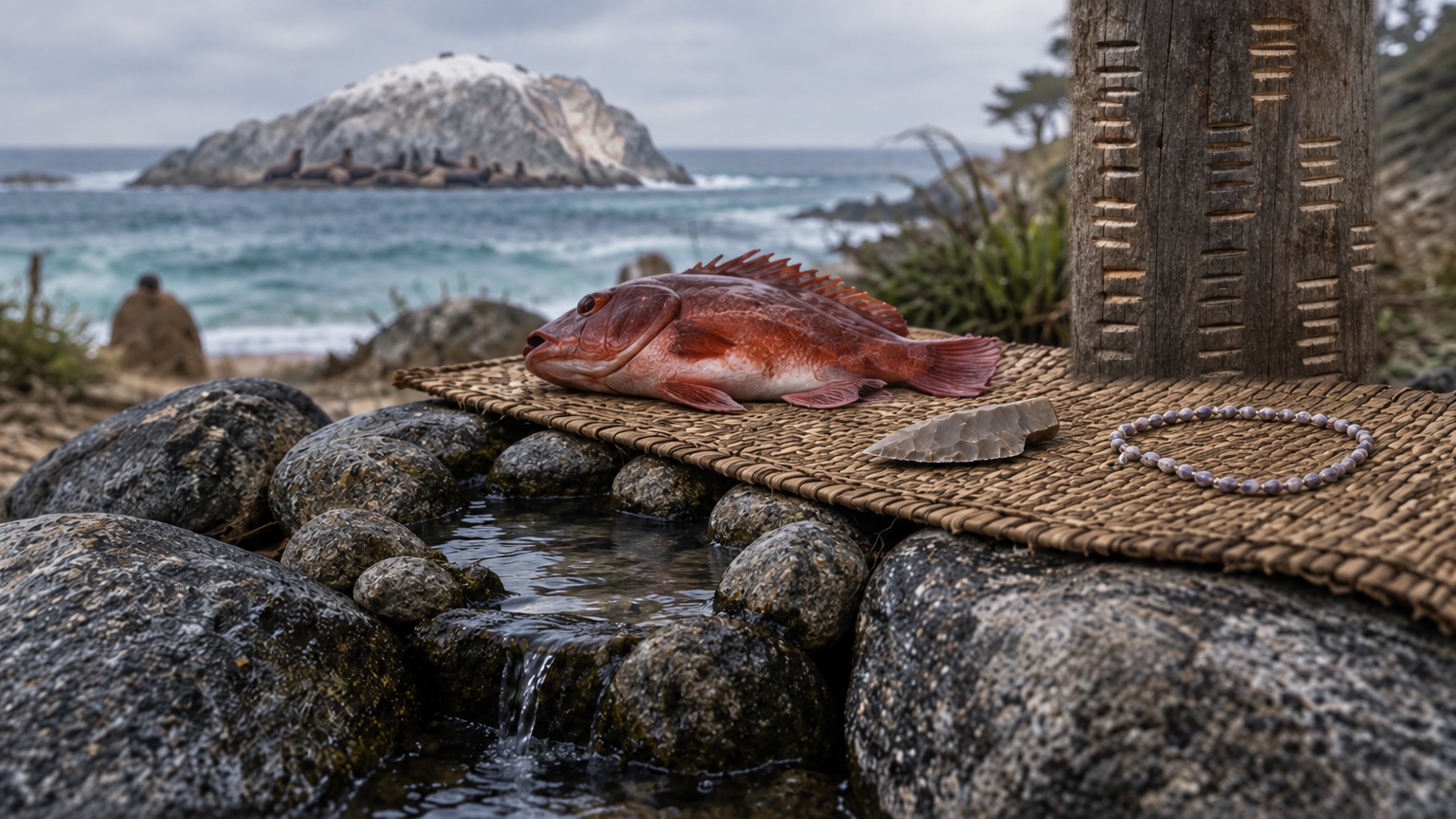
The offshore rock sat three hundred yards out from the point, dark with sea lions from the first storms to the spring, and the path across the granite bench was worn to a groove on the seaward side where every foot turned toward it the same way. Beside the spring where the coast path met the ravine trail, a market post, scarred with the season’s running notches, cleared and cut fresh every close. Keva had kept the spring thirty-one years and the accounts longer than that, since her grandmother had first walked her to the split boulder at the east tideline and pinched her hard enough to bruise, so that she would remember which face of the rock was the boundary and which was only stone. It wasn’t a gift. She had been taught it the way you were taught anything that mattered, by being hurt a little at the right moment.
“Is the net-mender clear with me?” a woman asked her, hardly breaking stride, a bundle of dried kelp under her arm.
“He owes you the second half of the cordage. He’ll bring it before the rains.”
“He said he already had.”
“He hasn’t.” Keva did not look up from the rockfish she was gutting for her own supper. “You’d remember if he had. You’d have told your sister, and your sister would have told me, because your sister tells me everything.”
The woman laughed, once, and went on to find the net-mender.
This was the ordinary work of the office. A hundred small questions a market day, answered without weight, because most debts were nothing, a half-share of smoked herring, a day’s use of a hand-barrow, cleared inside the season and forgotten by everyone but her. She did not think of it as memory. She thought of it as a basket maker thought of the turn at the rim: who gave, who took, what year, what else had happened that year that anyone would remember it by. The season the spring ran salt after the big surge. The winter the offshore rock split and the smaller piece went under and the sea lions crowded to one side. The egg-gatherer’s wedding, before the egg-gatherer died. She could not have told you what day of the week it was without counting, but she could tell you, without counting, that the crab-trap woman had borrowed a fishing net from the widow at the top of the ravine trail in the same season the rock split, and had given back two nets the following spring, and so was clear, and had been clear for eleven years, and nobody but Keva and the widow, who was also dead now, had ever known the net existed at all.
Two days up the valley, at the big settlement, traders from the south kept accounts in knotted cords on sticks, and the headman’s nephew could read a cord that would outlast the debtor. Nobody up here had ever seen it done. It would not have helped them if they had. A cord could not be asked a question out loud in front of the whole market and answer before the asker had finished drawing breath, and that was what people wanted, most days: not proof exactly, but a voice that would not wait to be paid to tell the truth.
Lida stood at her elbow, as she had stood most market days for two years now, watching the fish come apart under Keva’s knife in four clean strokes. She was fourteen, the crab-trap woman’s youngest, and had asked to be taught, and Keva had not yet decided whether she would be any good at it. She listened too hard. She wanted to be told the trick.
“How do you hold it all,” Lida said, not for the first time.
“I don’t hold all of it. I hold what’s mine to hold. Most of what passes here settles itself inside a season and I forget it on purpose, like letting a wound close. What’s left is what didn’t close.”
Oram came to her before noon, which was itself a thing to notice, because Oram was not a man who came to anyone before he had to.
He stood the way men stood when they had rehearsed the standing. His son Tal was a little behind him, in a coat too good for a market day, and behind Tal, at a distance that meant nothing and everything, stood two people from the family his son was to marry into, waiting to see how this would go before they came any closer.
“I need to be declared clear,” Oram said, formally, loud enough that the stalls nearest the spring went quiet without appearing to. “Before witnesses. So that I can speak for my son.”
This was the last market before the winter storms closed the coast path, and everyone knew what speaking meant. A man who could not be declared clear of debt could not put his name to another man’s obligation, could not vouch, could not be the name a bride’s family accepted as surety that the winter’s arrangements would hold. Tal’s marriage did not need Oram’s blessing. It needed his name clean enough to lend.
“Clear of whom?” Keva asked, which was the question she always asked, because it was never a small thing to be asked to say a man clear of the whole world, only of what she actually knew.
“Of anyone,” Oram said. “Of everything owed on this ground. I’ve kept nothing back that I know of. Ask what you have to ask.”
He said it easily. He believed it. Keva had known Oram since he was younger than his own son was now, had liked him without particular reason for most of that time, liked him as you like a man who pays what he owes and does not make you remind him twice. There was nothing between them that should have made this hard, and its not being hard was exactly what made it hard.
“Give me a moment,” she said, and turned the fish over on the board, though it did not need turning.
Lida saw the pause. Nobody else did. It was not long, not by any measure anyone standing there would have named, but Keva’s pauses had a length as other people’s voices had a pitch, and this one ran past its length by the better part of a breath, and Lida, who had spent two years learning nothing else so well as the rhythm of her teacher’s silences, felt it like a held note gone on one beat too many.
Keva set the knife down.
“You’re not clear,” she said. “You owe the people of the man who lent you his boat. The use of that boat and a season’s worth of dried fish, given across two years when the herring didn’t run, the winter the rock split and the winter after, when nobody on this shore could put a full smoke-rack out to dry. It was never given back. Not the boat, not the fish, not the value of either. He never asked for it in his life. He’s nine years dead now and it’s still owed, because a debt doesn’t die with the man who’s owed it, it goes to whoever stands where he stood, and that’s his sister’s boy, down the coast, who’s never heard of it because nobody living but me remembers it happened.”
The market did not go silent all at once. It went quiet in a widening ring, the way water goes still outward from a dropped stone, until even the people who had not heard the words had stopped to look at the people who had.
“There were no witnesses,” Oram said. It was not a challenge. It came out of him like something that had to be tried, once, because the alternative was saying nothing at all.
“There were three. The egg-gatherer, who’s dead. His brother, who took the inland road south twelve years back and hasn’t been seen since, and may as well be. And me.” Keva looked at him, not unkindly, which was worse than if she had been unkind. “You were young. You’d have been ashamed to remember it yourself. That’s not a fault in you. It’s only that I don’t get to be ashamed on anyone’s behalf. That’s the whole of what I’m for.”
Oram did not argue further. There was nothing to argue with. Her word was the only record there had ever been of the thing, which meant her word was not evidence of the debt; it was the debt, entire, and contesting it would have meant contesting the office itself, and no one at this cove had ever done that and lived at this cove afterward.
The family waiting at a distance did not come any closer. After a moment they turned, unhurried, careful not to look like people leaving, and were gone up the ravine trail before Tal had finished standing where he’d been left standing.
Nobody told Oram he could pay off nine years in an afternoon. He knew it as well as anyone. The dead man’s sister’s boy was down the coast and had never heard of it, and by the time word reached him and came back, the storms would have closed the path and the marriage settled or not settled without Oram’s name anywhere near it.
Oram went. He did not go quickly and he did not go slowly. Tal went with him, a half step behind, as he’d come.
Keva picked the knife back up.
“Is the salt still at yesterday’s measure?” a man asked her, not ten breaths later, because the market did not stop for what had just happened, had never once stopped for anything Keva had ever said at that spring, and would not start now.
“It is. The boat that brought it hasn’t moved since it was measured, and neither has the salt.”
“You’re certain.”
“I’m always certain. That’s the only thing I have to sell here, and I don’t sell it twice a day at two different prices.”
The man went off satisfied. Lida was still watching her, and Keva knew what the girl wanted: for something to be said about what had just happened, some accounting of it, some place it could be set down and closed as the season’s small debts were closed. There wasn’t one. She had told the truth in front of the whole market because that was the office, and the office did not have a version of itself that made exceptions for a man she liked.
“Fetch the winter notch-board,” Keva said instead. “We’ll want to start it clean, before the rains close the path.”
Lida went for the board. The surf broke below the bench, the same sound it had made that morning and would make tomorrow, indifferent to who could still walk the coast and who could not, and Keva went back to the fish, and finished it, and by evening had answered eleven more questions that cost nobody anything at all.
♥ 2026 Paul Titangos · CC BY 4.0 · a story from Good Day Mockingbird № 7