Issue № 12 · Story II
De Veinte Kilos
Iztapalapa, May 2014. Chayo Montes called lotería for twelve Holy Weeks and now records street cries for two hundred pesos, on a phone, under a towel, behind the curtain of her stall. She is on forty trucks, selling bread and water and avocados down every street in the colonia, and the women come down to her voice in their robes. Then Doña Mati at the griddle next door sets a bathroom scale on top of the phone cases and tells her what the gas truck’s cylinders weigh.
Iztapalapa, Mexico City, a Wednesday in May, 2014.
By seven in the morning Chayo Montes has sold bread, drinking water and avocados on three streets, and she is still in her kitchen in her socks, looking for the coffee.
The bread goes by first. El pan, el paaan, pan calientito. She did that one in 2011 with a cold, and the baker’s son liked the cold and wouldn’t let her do it over. Then the garrafón truck from the purifier on Ermita, which she did too fast because the man was double-parked, and you can still hear it: agua-agua-agua, garrafón. Then the avocado man, who is from Uruapan and made her say Uruapan four times until she said it like someone from there. She has never been there. She stands at the stove and listens to herself go down the block, flat on the second agua as always, and takes down a cup.
It costs two hundred pesos and has cost two hundred since she started. You come to the stall on a Wednesday or a Saturday and tell her what you sell. She goes behind the curtain with her phone and a folded towel, and you leave with it on a USB stick, forty pesos more for the stick. You plug the stick into the amplifier on your truck, and the truck says it until the truck dies. A man who bought in 2010 has not paid her a centavo since, and she heard him at six-thirty. She is on forty trucks that she knows about. She will tell you forty. She told the teller at Banamex, and a priest at her cousin’s baptism.
She came to it from the lotería, twelve Holy Weeks at the fair and every fiesta in the delegación, calling cards over a microphone that cut out. What she knows from that, she knows better than her own phone number. A goes the farthest. O goes nearly as far. An e gets to the corner, and an i doesn’t get out of the house. Consonants are for people already standing next to you. At forty meters nobody in the history of this city has heard a k. So what a woman at a third-floor window gets is a tune with a couple of vowels in it, and she has her shoes on before she knows she’s heard anything. A man yelling el gas could be any man. Women in this colonia come down to Chayo in their robes. One of them told her so at the stall, not knowing whose voice it was, and Chayo sold her a phone case.
The only truck she never recorded is the pipa. Nobody needs telling. When the water comes they are already in the street with buckets.
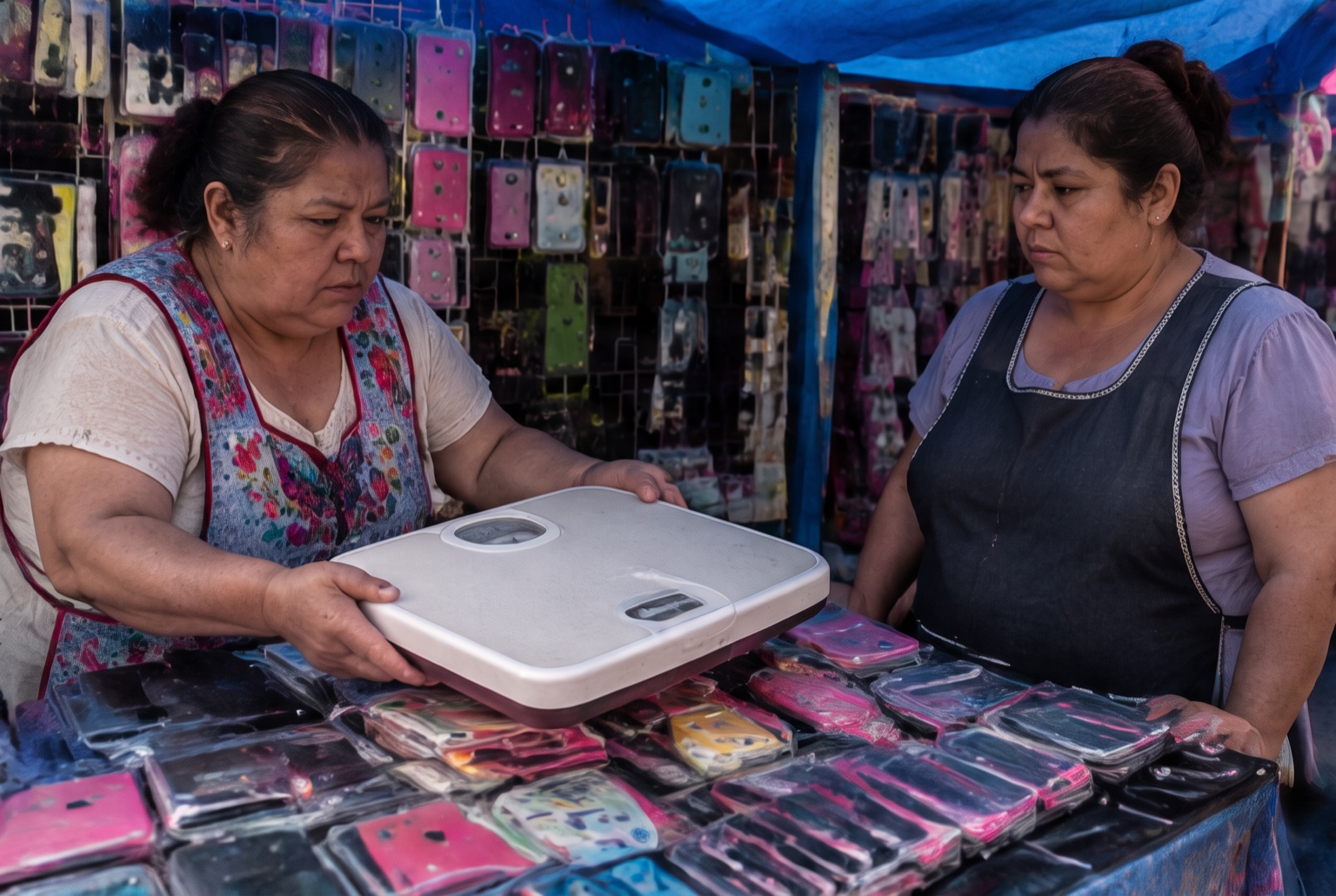
The tianguis sets up Wednesdays along the avenue, a kilometer of blue and pink tarps down one side. Chayo’s stall has phone cases, chargers, USB sticks, discs she doesn’t ask about, and the curtain at the back. For six years the stall next to hers has been Doña Mati’s griddle: quesadillas on blue masa, squash flower, huitlacoche when there is any, off a twenty-kilo cylinder chained to the table leg.
At half past nine Mati comes around the tarp pole carrying a bathroom scale and sets it on top of the phone cases.
“Mine quit yesterday. Nine days. It goes twelve.”
“Mati, I have customers.”
“You have nobody. I had my son put the new one on this. Thirty-five. The collar says seventeen-eight.” She waits. “You went to school.”
“Seventeen.”
“Seventeen and a little. Two hundred sixty pesos and change. And at seven this morning you stood under my window and told me twenty.”
It’s Beto’s truck she means, Gas Tezonco. El gaaas. De veinte kilos. Gas Tezonco, de veinte kilos. Chayo did it in 2012 when Beto’s doctor told him what he was doing to his throat, one take, and the owner paid. It is a good veinte. She puts the weight on the front of it and lets it fall off, so it sounds like a thing you could set down on a table.
“I didn’t tell you anything. I was in my kitchen.”
“It was you.”
“It’s a recording. They paid two hundred pesos. If they ask me to say the Pope is on the truck, I say the Pope is on the truck.”
“Did you know?”
“How am I going to know? I don’t carry them.” A boy has come up wanting a charger, and she sells it to him, forty-five, and gives him his five. “So buy from Gas del Cerro.”
“Who does Gas del Cerro?”
Chayo does Gas del Cerro. She did it last year, warmer, because the owner’s wife wanted it friendly.
“And what do theirs weigh?”
“How do I know what theirs weigh?”
Mati looks at her for a while. Then she takes her scale off the phone cases and goes back around the pole, and by ten she has a line.
Beto’s truck comes along the avenue a little after eleven. It can’t get through for the tarps, so it stops at the cross street and sings from there, and the cylinders go out on Beto’s shoulder. De veinte kilos. In Mati’s line a woman with a baby says to the woman behind her, not turning around, “Hold my place,” and goes to get her empty. Chayo unpacks a box of cases with cartoon cats on them. She has been told the cats are what people want.
He comes to her at noon, with his cap in his hand, which he only does when he is about to be charged for something.
“The stick’s going. It sticks. It says de vein, de vein, de vein, the whole length of Ermita. The Licenciado says get another.”
She has that file. She has all of them, on the phone and on a stick in the sugar tin. It would take four minutes and cost him forty pesos.
“That phone died on me,” she says. “I lost everything from before last year. I’d have to do it over.”
“Do it over?”
“Two hundred.”
He says something about the Licenciado and counts it out, and it’s the owner’s money anyway. He goes next door to get a quesadilla while she does it. She watches through the gap in the tarp. Mati gives him squash flower and takes his twenty pesos, and puts a little more salsa on it than he asked for, and says nothing to him at all.
Chayo goes behind the curtain and holds the towel over her head and the phone.
Diecisiete is a terrible word. It’s four syllables of e and i, built by somebody who never needed to reach a third floor. The first take dies in the towel. On the second she tries to get a run at it from de, and it comes out like a woman calling a cat. So she throws out the tune she gave veinte and hangs the whole thing on the one place it has any room, the sie, and lifts it and holds it there as long as she held the a in gaaas. She gets it on the third. El gaaas. De diecisieete kilos. Gas Tezonco, de diecisieete kilos. She plays it back once, for the height of the sie, and copies it to a stick.
Beto is wiping his hands on his trousers. “Do you want to hear it?” she says.
“What for? I know how it goes.” He drops the stick in his shirt pocket and takes a cat case off the pile, looks at it, and puts it back.
The afternoon is slow. Nobody buys a phone case after two. Around three the wind comes up with the dust off the Cerro, and people start weighting their tarps, and she is coiling chargers when she hears it two streets over and stops with a cable around her hand.
De diecisieete kilos.
It’s good. It carries better than she thought it would.
The truck works its way back toward the avenue. She can follow it by the windows. On Calle Morelos a woman comes down with her empty, and pays, and goes in with her full one, and doesn’t look at the roof of the truck. At the next corner two more. An old man in slippers rolls his to the curb on its rim and stands with his money out while it sings over his head, de diecisieete kilos, and he asks Beto about his mother. By the time it reaches the cross street it has sold six that she can see. Chayo finishes the cable and starts another. She has told forty trucks’ worth of people things for seven years.
The boys are what do it. Boys on bikes have followed her trucks all her working life, doing her, and they do her well; she has stopped in the street to hear a nine-year-old get the avocados. This one comes up the cross street behind the truck, standing on the pedals with no hands and his head back, and he has the tune already. He has the sie better than she does. He brings it down the line of griddles at the top of his lungs, past the woman with the baby, and his friend behind him comes in on the kilos.
Mati’s spatula stops.
She doesn’t look at the boy. She looks over the heads of her line to the corner, where Beto has a full cylinder on his shoulder and is coming toward her with it, because she ordered another for Saturday, and she calls out, in a voice that has sold quesadillas for thirty years, “Beto! How many kilos?”
“Twenty, Doña. Twenty, like always.”
De diecisieete kilos, says the truck.
Her line has turned around. So have the two stalls past it. Beto stops. He looks back over the cylinder at the megaphone on the roof of his truck as if the dog had said something. Mati wipes her hands and goes under the table and comes out with the bathroom scale, and she carries it through her own customers and sets it down on the asphalt of the avenue.
“Here,” she says.
“That’s a bathroom scale.”
“Here.”
He doesn’t put it down. He has worked out where to look by now, and he comes across to the blue tarp with the cylinder still on his shoulder and half of Mati’s line behind him. He is not a big man, and he’s sweating at the neck. “Chayo. What is that? What did you do?”
She sets the charger down. She doesn’t need a microphone. Twelve Holy Weeks, and she can reach the cross street without seeming to try.
“Thirty-five on the scale,” she says. “Seventeen-eight on the collar. You paid me to say what’s on the truck, and that’s what’s on the truck.”
Nobody says anything. The truck says it again.
“Take it off,” Beto says. “Chayo, por Dios, the Licenciado. Put it back how it was. What do I have to do to get it back how it was?”
Behind him Mati has her arms folded. The woman with the baby is looking at Chayo, and so are two of the griddle women, and she can see it starting in some of their faces, where they’ve heard that voice before.
She looks at Beto, and at the cylinder, and at the phone in her apron, and at the stick in the sugar tin, four kilometers away.
“Doscientos,” she says, and the o goes past the corner.
♥ 2026 Pete Kaminski · CC BY 4.0 · a story from Good Day Mockingbird № 12