Issue № 12 · Story III
Twice
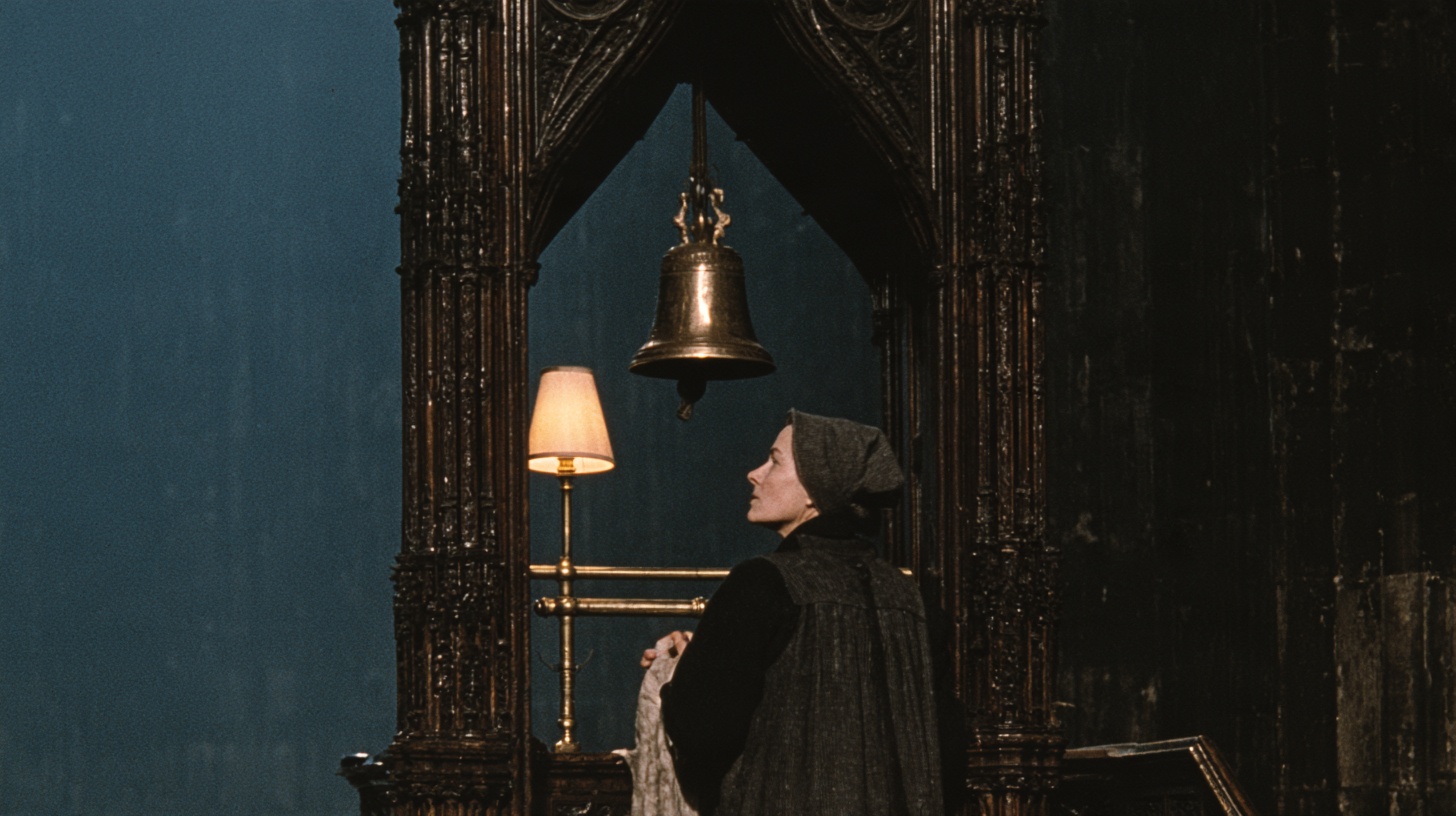
The Lutine Bell hangs over the rostrum at Lloyd’s, once for a loss, twice for an overdue ship come home, so that every man in the Room hears at the same instant. Walter Kemp has struck it eleven times in nineteen years, and the rest of the day he calls names and carries messages, and hears everything first. The Kestrel Bay has gone silent in mid-Atlantic and her reinsurance is climbing toward eighty guineas. A cleaner on the staff step asks him the number every evening, because her boy is on that ship. Then a telephone message comes up for the one underwriter who has been buying.
The Lutine Bell hung in the rostrum at Lloyd’s a hand’s width above Walter Kemp’s head, and in nineteen years as Caller he had struck it eleven times. Once meant a loss. Twice meant an overdue ship had come in. The bell had no other words and needed none, because the news was never the point of it. The point was that every man in the Room heard it in the same instant. Before there was a bell, word of a missing ship went through Lloyd’s the way it goes through any market, from the man who knew to the man who paid him, and the reinsurance on her changed hands on whispers until one of the whispers came true. When the bell rang, trading on that ship stopped where it stood. Then the Caller read the notice aloud, and nobody in the Room knew a word more than anybody else.
The rest of the day Walter called names. The Room was never quiet. Underwriters sat at their boxes in long rows, brokers queued at the boxes with their slips, and the sound of it all was a full church before the service, with the rates moving underneath. The rostrum had its own telephone, and messages for members came up to it all afternoon. Walter took them down on a pad that kept a carbon, laid the slips face down in a wooden tray in the order they arrived, and called each name in its turn until the man came up the steps to collect. A slip marked urgent went to the front. Nobody had ever written that down. It was a courtesy, and members paid for courtesies at Christmas. So Walter heard everything first. Which broker was in trouble with his bank, whose wife had rung twice before lunch, whose doctor wanted to see him Friday. None of it was his. It went into the tray and came out again in somebody else’s hand.
The Kestrel Bay sailed from Halifax on the second of January with wheat for London, five thousand tons of Pyke Line steamer out of Liverpool. On the sixth she sent her position from the middle of a westerly gale. After that, nothing. A ship that reports every day and then stops has either sunk or broken down, and the overdue market exists to put a price on the difference. On the eleventh a broker was carrying a slip around for her at fifteen guineas per cent. By the fourteenth it was thirty. By the seventeenth she was three days past due at Gravesend, the rate was fifty, and the Room had started saying her name in a lower voice, the way it did for a ship it was getting ready to lose.
Lionel Crane wrote her at fifty. His box stood ten yards from the rostrum, and for twenty years he had made a comfortable living writing ships the rest of the Room had stopped believing in, on the theory that a steamer gone silent in winter has broken her shaft more often than she has gone down. He called the ships by their rates. “How’s my fifty?” he’d ask the Room at large, coming back from lunch, and the Room would tell him, because the Room told everyone everything eventually. He wrote her at sixty and at seventy. He took her off frightened men a slice at a time, mostly off young Ashby, who had written the lead on the Kestrel’s hull in November, his first year on a box, and who came up to the rostrum on the nineteenth to ask Walter, very quietly, whether the waiters kept aspirin.
The cleaners came on at six as the waiters went off, and the two shifts passed each other at the staff door onto Lime Street. On the evening of the fourteenth a woman in a headscarf stopped Walter on the step. “You’re the one up top,” she said. “With the bell.”
Her name was Ivy Lyle. She came in from Poplar five nights a week and had done the Room for six years. Her boy Terry was sixteen and deck boy on the Kestrel Bay, his first trip deep sea, signed on at the Royal Docks in December with a new kitbag she was still paying off at two shillings a week. Her neighbor’s husband read the City pages. He had shown her the line about the reinsurance at thirty guineas and explained it to her. The gentlemen at Lloyd’s put the chance that her boy’s ship was on the bottom at near enough thirty in a hundred.
“Who puts it?” she said.
“The Room.”
“And who’s the Room?”
Walter had been a waiter thirty-one years, and nobody had ever asked him that. “Everybody,” he said. It wasn’t an answer, and she knew it wasn’t.
He told her about the bell because she asked, and because she had polished the brass on the rostrum every night for six years and never once heard it ring. It rang in the daytime. Once was a loss, he told her. Twice was home. After that she was on the step every evening she worked, and every evening she asked him the number, and he gave it to her. Forty. Fifty. Sixty. Seventy. It would be in the papers by morning anyway, and he told himself he was giving away nothing that wasn’t already given. She took each number the way you’d take a temperature off a sick child, and went in to do the Room.
On the night it was seventy she asked him something else. “Is there anybody in there thinks she’s all right?”
Walter thought about the Room, and about the box ten yards from the rostrum. “One,” he said.
“What’s he like?”
“He’s in it for the money, Mrs. Lyle.”
She nodded as if that were a reference. “Then he’ll have looked,” she said. On the twenty-second he gave her eighty.
At ten past two on the twenty-third the rostrum telephone rang, and a man with a Liverpool voice said, “Message for Mr. Crane. Urgent. Dunn at Pyke’s.” Walter wrote it down as Dunn read it out, with the time at the top.
KESTREL BAY SPOKEN BY LAMP 0800 TODAY BY NORWEGIAN TANKER VARNES MID ATLANTIC. SHAFT BROKEN. AERIAL CARRIED AWAY. TANKER STANDING BY. MASTER REPORTS ALL WELL.
“Read it back,” Dunn said. Walter read it back, and Dunn rang off. Pyke’s would be on to Lloyd’s own Intelligence Department as well, in a minute or in half an hour, and the notice would come up the rostrum steps once Intelligence had checked it. A clerk at Pyke’s had rung Crane first.
Walter knew what the slip was worth, because he had spent a fortnight watching it be worth something. Until the bell, a man who knew could take every frightened line left on the Kestrel Bay at eighty guineas. Ashby still held the last of his lead. He would pay Crane eighty-four pounds in every hundred to be rid of a ship that was already safe, and he would thank him for it.
Walter tore the slip off the pad and folded it once. He did not put it at the front of the tray. He put it at the back, behind nine others, face down, and called, “Mr. Hollis. Mr. Hollis, please.”
Crane came up the steps at twenty past without being called. “Anything from Liverpool?”
“In its turn, sir.”
Crane looked at the tray. He had tipped the rostrum every Christmas Walter had stood on it, and he knew what a slip at the back of it meant. He also knew he couldn’t raise his voice. A member quarreling with the Caller over a message from Liverpool was news, and the Room would have the Kestrel’s rate moving before he got his breath back. So Crane smiled out at the Room, leaned on the rail, and spoke so low that Walter had to watch his mouth.
“Give it here, Kemp.”
Walter laid his hand flat on the tray. “Mr. Pell,” he called. “Mr. Pell, please.”
“Nineteen Christmases I’ve seen you right.”
“Mr. Garside.”
“Think about your pension. Waiters are easier to come by than overdues.”
“Mr. Abbott, please.”
He called them at his ordinary pace, no faster and no slower, and each man came up the steps and took his slip and went back down into the noise. Crane stayed at the rail. Twice a broker looked up at him there and away again. The Room had noticed him, and it hadn’t yet decided what he meant. At twenty-five to three, with two slips still ahead of his, a boy from Intelligence came up the other side of the rostrum with a typed sheet.
Walter read it. For as long as the reading took, he was the only man at Lloyd’s who knew, and he let it last exactly that long and no longer. Then he reached up and struck the bell twice.
At the first stroke the Room went silent, as it always did, with every pen in the place stopped above its slip. At the second stroke it came apart. Men stood up at their boxes and cheered. Someone banged a ledger on his box like a drum. Down the third row, Ashby sat very still at his box and looked at nothing. Walter waited for the noise to die down, and then he read the notice into the quiet after. The Kestrel Bay, Halifax for London, overdue, spoken by lamp at eight this morning in mid-Atlantic by the Norwegian tanker Varnes. Shaft broken, wireless out of action, tanker standing by. There was nothing on the sheet about her crew. The Room had not insured a single one of them.
Then he called the two names still ahead of it, and when those men had come and gone he called, “Mr. Crane,” and Crane, who was standing at his elbow, put out his hand for the slip and read it. The time was written on it in Walter’s hand.
“Ten past two,” Crane said.
“Ten past two, sir.”
Crane would not take it to the Committee. To complain that the Caller had sat on his message, he would have to say what had been in it, and who at Pyke’s had given the owners’ news to an underwriter before the owners gave it to Lloyd’s. Walter had worked that out at ten past two as well.
“You know what that number was, all fortnight?” Crane said. “It was me. Without my pen she’d have been at ninety by the weekend. Every guinea under that was mine.” He put the slip in his waistcoat and went down to his box to collect on a ship he had been right about from the start.
Ivy Lyle was on the step at six with her bag over her arm. “What’s the number?”
“There isn’t one.” He saw that land, and went on quickly. “There’s nothing left to sell. They rang it at twenty-five to three. Twice.”
She put a hand on the doorframe. “Twice,” she said. Then, “And Terry?”
He could have told her that every number he’d given her on this step had come off Lionel Crane’s pen and not off the sea. He didn’t. The pad on the rostrum kept a carbon of everything, and at five to six Walter had torn out the carbon of Dunn’s message and folded it into his breast pocket. In thirty-one years it was the first thing he had ever taken off the rostrum that wasn’t his.
He gave it to her, and she held it up to the lamp over the door because the carbon was faint. He showed her where to look, past the tanker and the shaft and the aerial, to the four words at the end. She read them twice. Then she folded the carbon small, put it inside her glove, and went in to do the Room.
♥ 2026 Claire Jacobs · CC BY 4.0 · a story from Good Day Mockingbird № 12