Issue № 12 · Story I
Read at the Hour
Venice, the Rialto, one morning in 1584. Zuane Dal Moro has read the Signoria’s papers from the Gobbo’s steps for twenty years, at the bell, in time with a man at San Marco he has never once heard. This morning’s paper says the Pisani bank is suspended from all payment. It is three hours to terce, there is already a line at the bench, the fishwives have stopped taking bank money, and his widowed sister’s dowry is in the book. A comandador who reads early is a traitor. There are always boys who would run to San Polo for a soldo.
Venice, the Rialto, one morning in 1584, from dawn to terce.
The paper was waiting for him in the chancery at first light, folded in three, with the seal of the Provveditori sopra Banchi still soft at the edge where the wax had been pressed too thin. The secretary’s boy held it out across the table without looking up. He was copying something else.
“Rialto,” the boy said. “At terce. San Marco has the other.”
Zuane took it into the courtyard and read it once standing, by the well, with his back to the boy’s window. He always read a paper once before he read it aloud. It was not to understand it. Understanding was not required. It was to find the breath — where a sentence ran long, where the clerk had stacked three titles in front of the noun, where a number fell at the end of a line and wanted a pause after it so the back of the crowd could catch up.
The Most Illustrious Lords Provveditori over the Banks make it known and manifest to every person of whatever condition that the bank of the magnificent Messeri Pisani and Tiepolo is from this day suspended from all payment—
It went on for a page and a half. The creditors were to present themselves. The books were sealed. Nobody was to molest the bankers’ persons or their houses, on pain of the galleys.
He found the breaths. There were nine. He folded it back in three along the clerk’s folds and put it inside his coat, flat against his shirt, and went out by the Porta della Carta into the piazzetta, where the sweepers were out and the light was coming off the water grey.
There were two ways to the Rialto and he took the Mercerie, because it was the way he always took, and because anybody watching a comandador with a paper in his coat would be watching to see if he went any other way.
Shutters were coming off along the street, the glovers and the mirror sellers and the silk men laying out the morning. A cloth merchant he knew lifted a hand to him. Zuane lifted his. Nobody asked what he was carrying. It was not done, and in any case there was always something; a sentence, a new tax on wine, a ship come in from Alexandria, a list of the names of men who had been banished and who would be killed with impunity if found inside the borders. He had read all of those. He had read a man’s name on a morning when the man was standing in the crowd, and the crowd had turned round to look at him, and Zuane had gone on to the next name at the same pace, because the pace was the job.
He was fifty-three and had a voice that carried across the canal on a still morning to the steps of the Ca’ da Mosto on the other side. People had told him so. He had not been across to check.
At the top of the Mercerie he stopped at the bread stall and bought a roll he did not want, and stood eating it.
His sister Lucietta lived in San Polo, past the Frari, on a calle that had no name anybody used. From the foot of the Rialto it was four bridges, and most of an hour there and back. He had walked it often enough. He knew to the bridge where his left hip would start.
Her husband had been dead two winters. When the estate was settled she had got her dowry back out of it, as the law gave a widow, after a year of the brothers-in-law disputing the linen. Nine hundred ducats. She had put it in the Pisani bank, at the bench at San Giacometto, because their father had banked there, and because a ducat in a banker’s book did not burn or get stolen or get lent to a nephew. She lived on what she drew from it. She had told him the figure once, at table, with some pride.
He finished the roll. It was terce in three hours, a little less.
The wooden bridge was already full when he came over it, porters with baskets on their heads coming down the middle. The Senate had been arguing about a stone bridge since before he was born.
From the top he could see the whole market. The wine boats were in along the Riva del Vin, the greens were coming off the barges at the Erberia, and the fish market was already loud on the right, under its awnings, the fishwives calling the boats in by their owners’ names. Ahead was the campo, and the little church of San Giacometto with its clock, and under the portico in front of the church, where the bankers had always sat, the bench.
There was a line at the bench.
He saw it as he saw a crowd at a reading, as a shape before it was people. It went from the bench along the portico and out into the campo and bent round the Gobbo, crouched at the foot of the steps he would climb, so that some of the people in the line were standing against the stone with their shoulders. Men mostly. A few women. The bank’s clerk was at the bench with the book open, and a second clerk beside him, and the first clerk was writing slowly and paying out coin more slowly still, with a care that looked, from the top of the bridge, like ordinary care.
Zuane came down off the bridge and went into the fish market, because it was nearer than the line, and because he needed to be somewhere for three hours that was not the steps.
A woman was selling sardines to a cook from one of the big houses. The cook was offering to settle in bank, to walk her over to the bench and have the sum moved across in the Pisani book, which was how cooks from the big houses paid for everything at the Rialto and had for a hundred years. The woman shook her head without looking at him.
“Coin,” she said.
“It’s the Pisani.”
“Coin, or sell me something I can eat.”
The cook paid in coin. The woman next along, who sold eels, said something Zuane did not catch and the sardine woman laughed. A boatman was standing at the end of the stalls with his oar on his shoulder, talking, and two women and a porter were listening to him with the particular stillness of people being told a thing first.
Zuane bought nothing. He went out the other side and walked the length of the Ruga, past the goldsmiths, and came back. At a cheese stall a man was offering to pay in bank for a whole wheel, and the cheese man was offering him a third of a wheel on those terms, and the man was taking the third.
So it was in the price.
He went and stood in the lee of the Drapperia with his back to the wall and his hand flat on the outside of his coat, where the paper was, and watched the line.
He could have sent a boy. There were always boys. A boy would go to San Polo and back for a soldo and say whatever you put in his mouth and forget it by the next bridge.
A comandador who read early was a traitor to the Signoria. That was the oath. A comandador who told one person was reading early; one person told a second person, and so on into the city until the paper was a thing that had been said in kitchens before it was said on the steps, and then what was the paper for.
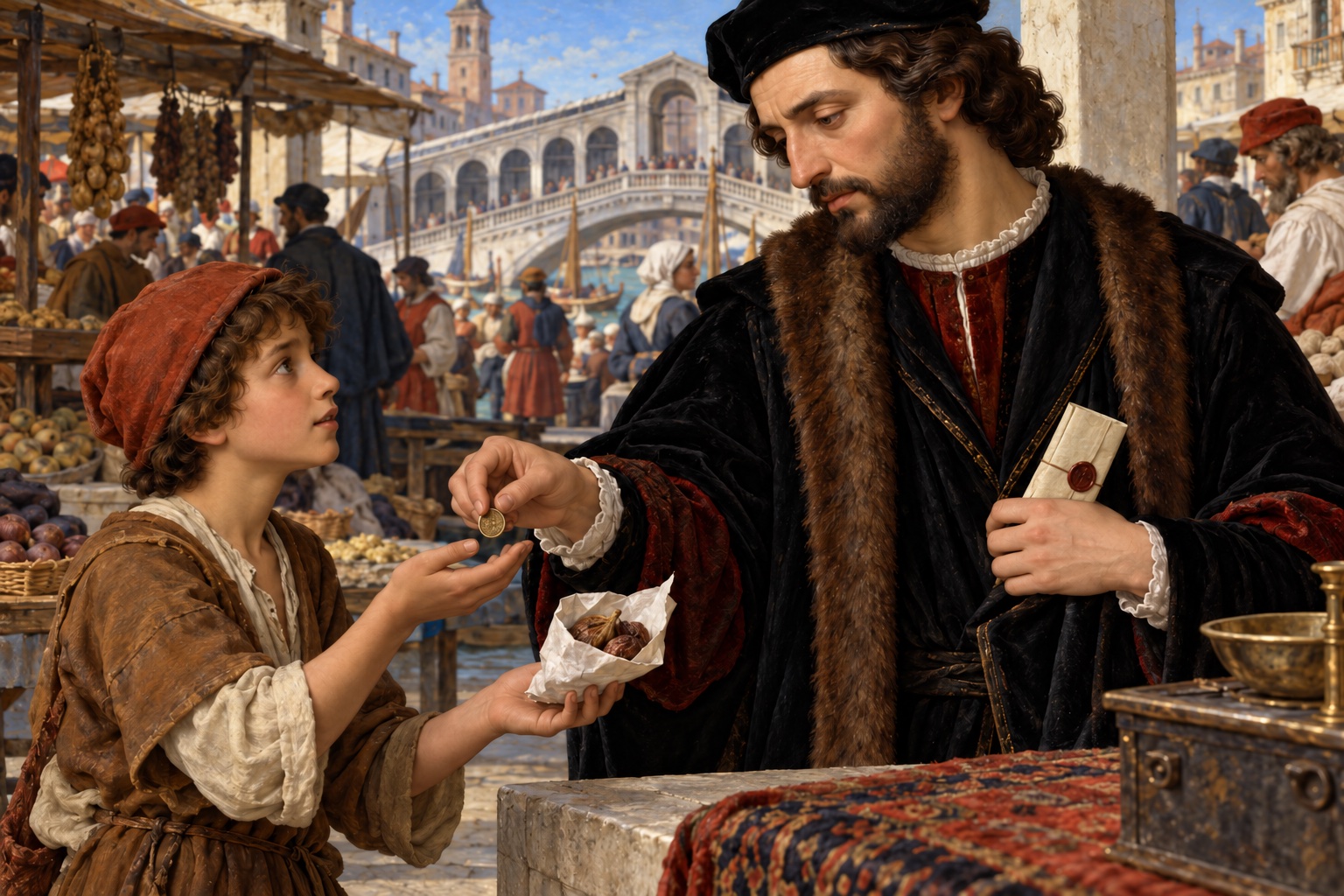
A boy came and stood near him, as boys did near a comandador with a paper in his coat, in case there was an errand in it. Zuane took out a soldo and gave it to him and sent him to the Ruga for a twist of dried figs. The boy brought them back. Zuane put them in his coat, beside the paper.
He looked for her in the line.
She would wear black. All widows did. Half the women in the line wore black. He worked up the line from the Gobbo, face by face, as far as the portico, where the columns and the shade under them took the front of it, and back again, and did not find her, and could not tell whether that was because she was not there or because there were too many.
The clock on San Giacometto had one hand and twenty-four hours, and nobody on the Rialto had set anything by it in living memory. He was listening for San Marco.
San Marco rang terce, and he heard it across the roofs a moment before the San Giacometto bell took it up, and he went to the steps.
A space opened for him. The line along the portico shifted, the men nearest the Gobbo stepped back off the stone, and he went up the little stair carried on the Gobbo’s shoulders to the platform at the top, from where he could see over the heads of the whole campo to the bridge.
He took out the paper and unfolded it. Somewhere on the other side of the city, on the porphyry stone at the corner of San Marco, Battista Scarpa was unfolding his. They had read together for twenty years, in time, at the same bell, and had never once heard each other.
He read.
The Most Illustrious Lords Provveditori over the Banks make it known and manifest to every person of whatever condition—
The first breath. It went out across the campo and he felt it reach the water and come back off the façades. The fishwives went on calling. The cheese man was cutting.
—that the bank of the magnificent Messeri Pisani and Tiepolo—
The second breath. Nobody turned. In the line, a man near the front put his purse away.
—is from this day suspended from all payment.
He let the pause sit after payment, as the sentence asked. Under the portico the first clerk had been counting coin onto the bench for whoever stood at the front. He stopped. He drew the coin back across the wood with the side of his hand, into the box, and closed the book. He did it without hurry. He set his pen in the groove of the bench, and the second clerk stood up and began taking down the cloth that hung behind them, and nobody in the line moved.
He read the creditors’ clause. He read that the books were sealed. He read on pain of the galleys, and someone in the fish market called out the price of eels.
There was no sound from the campo that he had not heard on any other morning. He had stood on that stone and read war with the Turk, once, and the crowd had made a noise he still heard. This was not that.
He read the last line, and the date, and the names of the Provveditori.
From the top of the steps he could see in under the portico to the front of the line. The first person in it, the one at the bench close enough to touch the book, was a woman in black. It was Lucietta. She had brought her own stool. Her hand was still flat on the wood where the coin had been. She was not looking at him. She was looking at the book.
He folded the paper back along the clerk’s folds, and missed one, and did it again.
He went back by the Mercerie.
In the chancery he took the paper out of his coat. The figs were still in there, beside it. He had not wanted those either. The secretary’s boy took the paper from him and turned it over and wrote on the back, in the formula, the day and the hour and published on the steps of San Marco and of the Rialto by Battista Scarpa and Zuane Dal Moro, comandadori, and blotted it.
“Was there trouble?” the boy said.
“No.”
The boy put the paper on the pile with the others and went back to his copying. Zuane stood a moment longer at the table. Then he went out into the courtyard, where the light was full now, and drew a cup of water from the well, and drank it.
♥ 2026 Paul Titangos · CC BY 4.0 · a story from Good Day Mockingbird № 12